Most walking holiday packing lists are written for people carrying everything on their back. The advice tends towards the extreme: go as light as possible, cut everything that is not essential, leave the extra layer at home.
On a SloWays self-guided walking holiday, the calculation is different. Your main bag travels ahead to the next accommodation while you walk. You are not carrying your life on your back. You are carrying what you need for the next few hours.
That changes the packing question entirely. It is not "how do I fit everything into one bag?" It is "what do I actually need while I am walking, and what can wait for me at the next hotel?"
This guide is built around that distinction, with everything organised into two categories: your daypack, which stays with you on the trail, and your transferred luggage, which meets you at the end of each stage.
In short: On a SloWays trip with luggage transfer, pack two bags. Your daypack holds what you need during the walk. Your main bag holds everything else and travels ahead. The allowance for transferred luggage is one bag per person, up to 20 kg.
If you’re looking for inspiration for your next Camino, or want help choosing the itinerary that best matches your needs,
take our quiz at the link below!
On SloWays itineraries that include luggage transfer, you leave your main bag at the accommodation each morning according to the instructions in your travel documents. While you walk the next stage, the bag is transported to your next overnight stop and will be waiting when you arrive.
The allowance is one piece of luggage per person, with a maximum weight of 20 kg. Even without carrying the bag yourself, packing deliberately makes every check-in and transfer more straightforward.
Your daypack is what you carry on the trail. It should contain everything you might realistically need between leaving the accommodation in the morning and arriving at the next one in the afternoon. Everything else goes in the transferred bag.
The simplest way to decide where something belongs: will I need this while I am walking today? If yes, daypack. If not, transferred luggage.
A 15 to 20-litre hiking daypack is the right size for most walking stages. Anything larger encourages overpacking; anything smaller makes it difficult to carry a full waterproof layer alongside enough water for the day.
Water: carry enough for the stage, adjusted for the weather and refill opportunities. On exposed or longer stages, err on the side of more rather than less.
Food: a couple of snacks, and a packed lunch on stages where villages or cafés are sparse. Your travel documents will indicate where food is available along the route.
Waterproof jacket: packable, and kept accessible rather than buried at the bottom. Weather on exposed paths can change quickly, and stopping to unpack the bag in the rain is worth avoiding.
Insulating layer: a light fleece or mid-layer for stops, ridge crossings, or cooler mornings. Even in summer, a shaded descent can feel considerably colder than the climb that preceded it.
Waterproof pack cover or dry bag: keeps the contents of your daypack dry when the waterproof jacket is on your back rather than in the bag. Useful on any route where rain is a realistic possibility.
Sun protection: hat, sunscreen, and sunglasses. On open southern routes from spring onwards, these are not optional.
Phone and power bank: your navigation app, offline route files, and accommodation contacts all live here. A full day of GPS use drains a phone battery quickly; carry a charged power bank and do not rely on finding a socket mid-stage.
Blister kit: plasters and zinc oxide tape. Carry these from day one, applied at the first sign of a hot spot rather than waiting to see whether it develops.
Personal medication: anything you take daily or might need during the day.
Wallet and ID or passport: always in the daypack, never in the transferred bag.
Route documents: anything you may need to reference on the trail.
Place heavier items, water and power bank in particular, close to your back and as high as possible. This keeps the weight centred and reduces strain on your shoulders over a long day. Your rain layer, blister kit, and water should be reachable without unpacking the whole bag.
Take your daypack on at least two training walks before the trip, loaded with roughly what you plan to carry. This is how you find out whether the shoulder straps dig in, whether the chest strap sits at the right height, and whether you know where everything is when you need it quickly. The first walking trip checklist covers daypack fit and preparation in more detail.
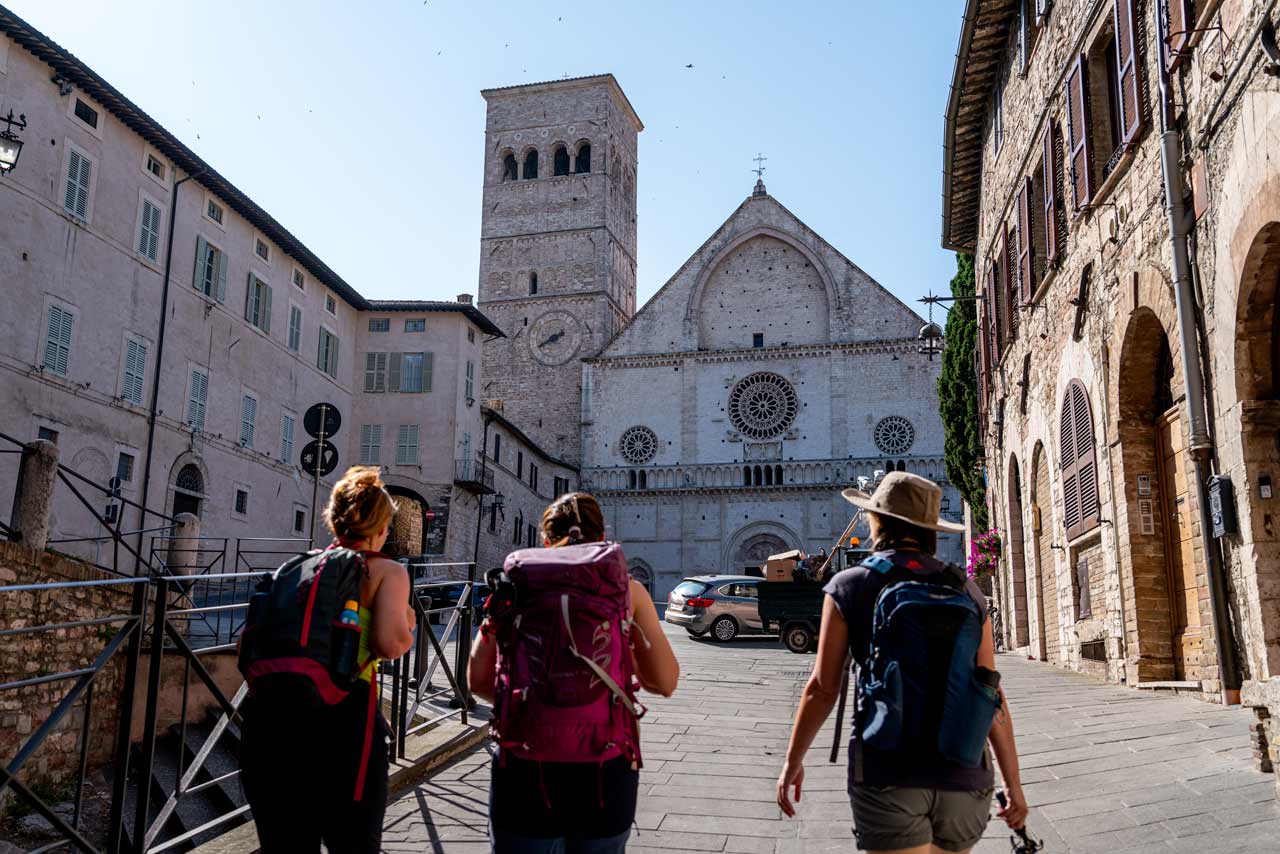
Because you are not carrying your main bag yourself, you have considerably more flexibility than a traditional backpacker. The goal is not to pack as little as possible, but to pack deliberately: only what you will actually use, organised so that finding things at the end of a long day takes no effort.
Walking clothes are worn repeatedly on multi-day trips. Two to three sets of walking kit is enough for most itineraries, on the assumption that you will hand-wash items in the evening where facilities allow.
Merino wool or synthetic base layers (two to three, depending on trip length)
Walking socks in merino or synthetic fabric (two to three pairs)
Lightweight walking trousers or shorts; a second pair is useful on longer trips
Comfortable clothes for the evening, kept separate from walking kit
A warmer layer for evenings, particularly relevant in spring, autumn, and at altitude
A second waterproof layer if the route or season calls for it
Your walking shoes or boots travel on your feet. A lighter pair of shoes or sandals for evenings is worth including in the transferred bag. After a long stage, your feet will be grateful for the change.
Pack what you know you will use. What is provided at your accommodation depends on the property, so check your itinerary documentation rather than assuming.
Toiletries in travel sizes
Any prescription medication not needed during the day
Chargers and electrical accessories
A laundry bag for separating worn walking kit from clean clothes
Any personal items only needed at the accommodation
Keep passports, travel insurance details, accommodation confirmations, and emergency contact numbers in your daypack, accessible throughout the day. A printed copy of your accommodation list and key contacts is a sensible backup if your phone battery runs out at an inconvenient moment.
Footwear has a greater effect on the quality of a walking holiday than any other item you pack. Get this right and most other discomforts become manageable. Get it wrong and the rest of the list barely matters.
The most important rule: whatever shoes or boots you choose, walk in them properly before the trip. Not once around the block, but on several proper walks including at least one long enough to match a typical stage on your itinerary. If they are going to cause a problem, far better to find out at home.
A few things that matter more than most people expect:
Socks: a merino wool or synthetic walking sock reduces friction compared to a cotton everyday sock. Always wear the same socks you plan to use on the trip when breaking in your footwear. Sock thickness changes how a shoe fits, so do not switch to a different pair on the day.
Fit at the end of the day: feet swell during a long walk. If possible, try new footwear in the afternoon rather than the morning to get a more accurate sense of the fit.
Change one thing at a time: if you are also testing new insoles or socks, introduce changes separately. If something causes a problem, you need to know what it was.
Walking shoes rather than full boots work well for most SloWays itineraries, particularly on lower-difficulty routes with good paths. Boots offer more ankle support on rougher terrain and in wet conditions. Your route documentation will note where a stage calls for more substantial footwear.
The same route packs differently in April and in August. Season is one of the most practical variables to account for before you finalise what goes in each bag.
Conditions vary considerably across Europe in spring. On southern routes such as the Via Francigena through Tuscany or the St. Francis Way in Umbria, temperatures are comfortable and afternoons can be warm, but mornings are often cool and afternoon showers are common through May. A packable waterproof, a light fleece, and a base layer cover most situations. Sun protection becomes relevant from late April onwards.
On northern routes, spring arrives later. In Norway or the Netherlands, April and May can still feel like winter mornings. Pack an additional warm layer and treat the waterproof as essential rather than precautionary.
On Mediterranean and southern Italian routes, heat is the primary consideration. Lightweight, breathable fabrics make a real difference over a long stage. A sun hat is not optional on open paths. Carry more water than you think you will need, and plan to start each stage early to avoid the midday heat. Keep your rain layer accessible regardless: summer thunderstorms can arrive quickly in mountain areas and along exposed coastal paths.
On northern routes and at altitude, summer is generally the most comfortable season, though temperatures can drop sharply in the evenings. A warm layer for after the walk remains useful.
Daylight hours shorten noticeably from October, which is worth factoring into longer stages. On many routes, conditions can be more changeable than in summer, so a reliable waterproof earns its place. An extra warm layer for evenings is worth including from late September, particularly at altitude and on northern routes.
Walking in winter is possible on selected southern routes. Warmer layers, good waterproofing, and early starts to make the most of available daylight are all relevant. Check your itinerary documentation for any seasonal notes specific to your route, as conditions vary considerably by location.
The 7 tips for walking in the rain covers wet-weather preparation in more detail for trips where changeable conditions are likely.
Packing for a walking holiday with luggage transfer is not about minimalism. It is about packing deliberately: bringing what you will actually use and leaving out what you will not.
A few things that commonly appear on packing lists but rarely earn their place:
Multiple pairs of walking trousers: one pair is usually enough, with a second useful on longer trips. Lightweight walking trousers can dry quickly when hand-washed, though drying time depends on the fabric and conditions.
A sleeping bag or heavy liner: what is provided at your accommodation depends on the property, so check your itinerary documentation. On most SloWays trips, bedding is included, but this varies.
A paper guidebook: your SloWays travel documents and the navigation app contain everything you need for navigation and route information. A guidebook is unnecessary for finding your way, though some walkers find one useful for cultural or historical context along the route.
Items packed "just in case" with no specific use in mind: if you cannot identify when you would use something, it probably does not need to come. The 20 kg allowance is generous; it is not an invitation to fill the bag.
Every extra kilogram in your transferred bag is felt when you are moving between accommodations. Every extra gram in your daypack is felt by the end of a long stage. Pack what you need, and pack it well.
Daypack (carry with you on the trail)
Water, adjusted for the stage, weather, and refill opportunities
Snacks and packed lunch where the route passes through areas with limited food stops
Packable waterproof jacket, kept accessible
Light insulating layer (fleece or mid-layer)
Sun hat, sunscreen, and sunglasses
Phone with offline maps and route files downloaded
Portable power bank, fully charged
Blister kit: plasters and zinc oxide tape
Personal daily medication
Wallet, ID or passport, and valuables
Waterproof pack cover or dry bag
Route documents for the day
Transferred luggage (travels to the next accommodation)
Merino or synthetic base layers (two to three sets)
Walking socks in merino or synthetic fabric (two to three pairs)
Lightweight walking trousers or shorts (one pair, two for longer trips)
Evening clothes and a warmer layer
Comfortable shoes or sandals for evenings
Toiletries in travel sizes
Chargers and electrical accessories
Laundry bag
Prescription medication not needed during the day
Spare waterproofing or additional layers adjusted for the season
Full details of the SloWays luggage transfer service, including the 20 kg allowance and how the service operates on each itinerary, are on the luggage transfer page. If you have questions about packing for a specific route or time of year, the team is happy to advise before you travel.
Packing for a walking holiday with luggage transfer is more straightforward than most people expect. Your daypack carries what you need for the next few hours. Your main bag carries the rest and meets you at the end of the day.
The goal is not to pack as little as possible. It is to pack what you will actually use, in the right bag, so that the walking itself can be the focus rather than the logistics around it.
If you are preparing for your first multi-day trip, the first walking holiday in Italy guide and the first walking trip checklist cover preparation in more detail, including training, footwear, and what to expect on the trail.
Browse SloWays walking holidays with luggage transfer across Europe, or get in touch if you would like packing advice specific to your route and the time of year you are travelling.
Written by the SloWays Team
 Nominee Best Specialist Tour Operator 2026