Most people planning their first walking holiday spend weeks choosing the right route and not nearly enough time thinking about the week before they leave. That is where the real preparation happens, and where most of the avoidable problems begin.
The questions that tend to surface at this stage are familiar: Am I fit enough? Will my shoes hold up? What if I pack the wrong things? They are perfectly reasonable questions, and none of them require specialist gear or a training plan borrowed from an ultramarathon runner. They just require a few practical decisions, made early enough to matter.
The most common first-trip mistakes have nothing to do with fitness. They come from brand-new shoes, an untested daypack, and the belief that a 15-kilometer stage is the same effort regardless of heat, terrain, or how much sleep you had the night before.
On a self-guided trip with us, the route, accommodation, navigation, and luggage logistics are already in place before you set off. Your job is simply to arrive prepared to enjoy the walk.
Still deciding on your route or difficulty level? Our guide to choosing your first walking holiday in Italy covers all of that. This article picks up where that one ends.
If you’re looking for inspiration for your next Camino, or want help choosing the itinerary that best matches your needs,
take our quiz at the link below!

This is the single most repeated piece of advice in walking circles, and the one most often ignored. Shoes that feel comfortable in a shop behave very differently after four hours on uneven ground, descents, and wet paths. Wear them on at least three or four proper walks before you leave, including one that involves a hill. If they are going to cause a problem, better to discover it at home.
Always wear the same socks you plan to use on the trip. Sock thickness changes how a shoe fits.
Do not swap footwear, socks, and insoles all at once — if something goes wrong, you will not know which change caused it.
Bring blister plasters from day one, even if your shoes feel perfect.
Fashion trainers and everyday sneakers tend to offer insufficient support on longer stages on mixed terrain.
You do not need the most technical boot on the market. What you need is a shoe you have already walked in, on real ground.
The goal is not to push your limits in the weeks before you leave. It is to arrive with a body that is used to being upright and moving for several hours at a stretch. Many first-time walkers focus on distance when they should be thinking about duration — walking sixteen kilometers over mixed terrain with a daypack and a long climb feels very different from six kilometers on flat pavement.
Start with regular walks of 60 to 90 minutes, two or three times a week.
Gradually build to three to four hours on varied ground.
Take breaks during training walks, just as you will on the route. Stopping is not failure.
Leave a recovery day between longer efforts. Consistency matters more than intensity.
For a week-by-week approach, our full preparation plan covers progressive build-up and what to expect from different route types.

Fifteen kilometers sounds manageable until you discover that the last four are uphill, the temperature is 30 degrees, and you have been walking since early morning. Distance is a starting point, not the full picture.
What actually determines how a day feels:
Elevation: descents are harder on the knees than climbs, and long ascents slow your pace considerably.
Surface: loose gravel, cobblestones, and muddy paths require more effort than smooth tracks.
Heat: walking in summer in Italy at midday is a different experience from the same distance in cool autumn weather.
Your own rhythm: everyone has a natural walking pace. Trying to match someone else's is tiring.
The most valuable thing you can do on your first day is finish it feeling good. A comfortable start builds confidence for the rest of the trip. For guidance on choosing the right distance and difficulty, the first walking holiday guide covers this in depth. covers this in depth.
On most self-guided itineraries, your main luggage travels ahead to the next accommodation while you walk with a light daypack. You are not carrying your life on your back — you are carrying what you need for the next few hours.
Daypack essentials for a walking stage:
Water (1-2 liters depending on route, weather, and availability of refills)
A simple snack or two
A lightweight, packable waterproof layer
Sun protection: hat, sunscreen, sunglasses
Your phone and a small power bank
A basic blister kit: plasters, tape, a small needle
Any personal medication
A thin extra layer for stops
That list fits comfortably in a 15 to 20-liter daypack. More on how luggage transfer works on a self-guided trip.
None of this is about making the trip more complicated. It is about making it easier to forget the practicalities once you are on the trail.cticalities once you are on the trail.

Take your daypack on at least two training walks, loaded with roughly what you plan to carry. This is how you find out whether the shoulder straps dig in, whether the chest strap sits at the right height, and whether you know where everything is when you need it quickly.
Heavier items (water, power bank) should sit close to your back, as high as possible.
Shoulder straps should sit snugly but not tightly.
The chest strap, if your pack has one, takes pressure off the shoulders on longer carries.
Keep your rain layer, blister kit, and water accessible without unpacking the whole bag.
Do not overload it "just in case." Most of what people carry for emergencies stays untouched at the bottom of the bag.bottom of the bag.
We hear some version of this story every season: a walker who felt a small rubbing sensation on the second morning, decided it was nothing, and by the afternoon of day three was limping into the accommodation wondering whether they could continue. The blister was not the problem. The decision to keep walking through the warning sign was.
A blister that develops on day two of a seven-day route is not a minor inconvenience. It is something you will be managing, and walking around, for the rest of the trip. Prevention is genuinely easier than treatment, and it starts before you leave home.
The most common first-timer mistake: pushing through a hot spot because it does not feel like a real blister yet. By the time it does, the damage is done. The basics of blister prevention:
Broken-in footwear is the foundation. Everything else is secondary.
Socks matter more than most people expect. A merino wool or synthetic walking sock reduces friction significantly compared to a cotton everyday sock.
Keep feet as dry as possible. Change socks at lunchtime if they are damp.
Stop at the first sign of a hot spot. A small piece of tape applied early can prevent a problem from developing. Waiting to see if it gets better rarely works.
Carry plasters and tape from day one, not just from the day you think you might need them.
If a blister does develop, clean it, protect it, and consider whether the stage needs to be shortened.n two days of limping.
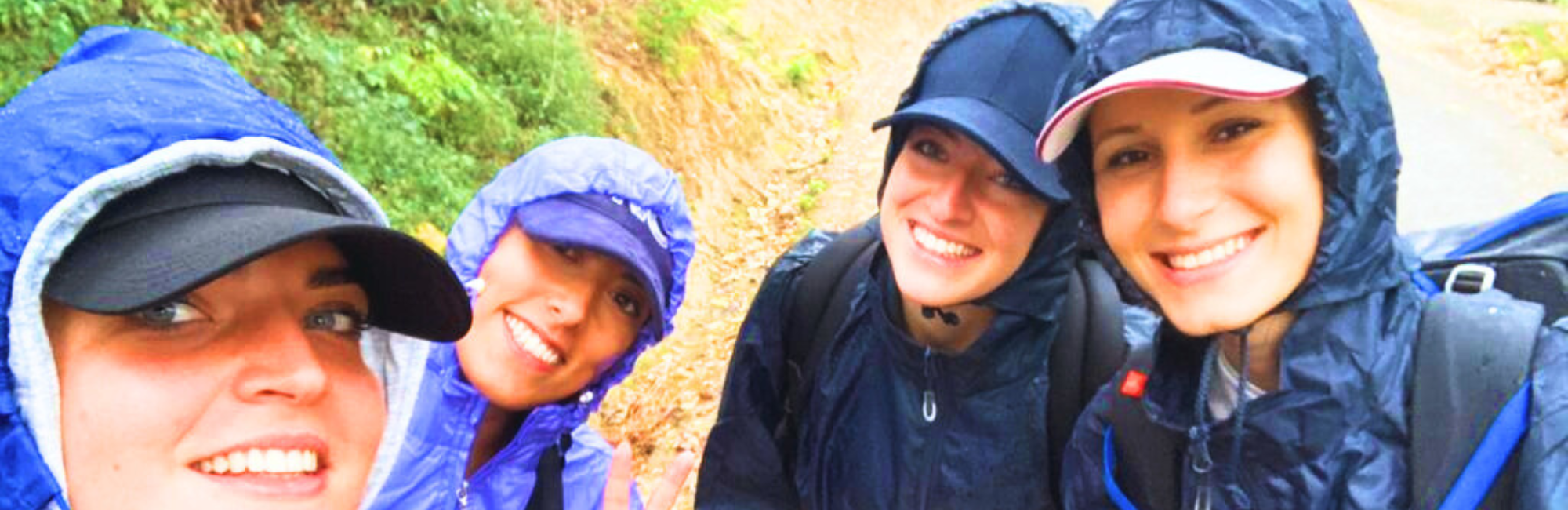
Summer walking in Italy can mean brilliant sunshine, a sudden afternoon storm, or both on the same day. The Tuscan hills in June and the Ligurian coast in September are beautiful, but neither is entirely predictable. Planning for weather changes is not pessimism; it is what keeps a wet afternoon from derailing the whole stage. What works well in practice:
Check the forecast the evening before and again in the morning. Conditions can shift overnight.
Use lightweight layers rather than one heavy jacket. A thin thermal, a fleece, and a packable waterproof cover a much wider range of conditions.
On hot days, start earlier. The first two hours in the cool of the morning are worth considerably more than the same distance in the midday heat.
Keep your rain layer accessible, not buried at the bottom of your pack.
A hat, sunscreen, and sunglasses are not optional in high summer on open paths.
The goal is to carry less and adapt more.eight layering allows.
By the time you feel thirsty, you are already slightly dehydrated. By the time you feel hungry on a long stage, your energy has already started to dip. On a walking holiday, the goal is to stay ahead of both.
Start the day with a proper breakfast. Even a light hotel breakfast gives you a foundation for the first few hours.
Drink regularly from the start, not just when you feel thirsty. A small amount every thirty to forty minutes works better than drinking a lot at once.
Carry a simple snack for mid-morning and mid-afternoon. The specifics matter less than the habit.
Build in a proper break. A twenty-minute stop for lunch or a coffee is part of the walking day, not an interruption to it.
One thing worth knowing about rural stages in Italy: small villages often have limited opening hours, and a bar or trattoria that looks open on the map may be closed on a Tuesday afternoon in August. The innkeeper who hands you your room key the night before is usually the best source of advice on where to eat along the next day's route. next day's route.
What is the point of arriving somewhere beautiful if you are too tired to look at it?
Stage times in route notes are usually calculated on a steady walking pace with minimal stops. They rarely account for a detour to a viewpoint, a longer-than-planned coffee in a medieval square, or the twenty minutes you spend talking to the farmer whose vineyard the path cuts through.
A walking holiday is not a race against the clock. The best stages are often the ones that leave room for exactly those moments.
If the notes suggest four hours for a stage, plan for five. Use the extra time to walk into a village you were not expecting to stop in, or simply to arrive at your accommodation with enough energy left to enjoy the evening. The dinner, the local wine, the light on the hills at seven o'clock — those are as much a part of the journey as the walking itself.
The goal is not to complete the stage. It is to experience it.
Arriving an hour earlier than you needed to often means a shower, a slow stroll through the village, and a table outside just as the square begins to fill for the evening. That is what all the preparation is for.
Phone navigation works well on the trail, but only if you have prepared it properly. Rural paths in Italy and across Europe often have limited or no mobile signal, and an app that requires a live connection is not much help when you need it most.
Before each stage:
Download offline maps for the route. Most navigation apps allow this; do it while you still have a reliable connection, ideally the evening before.
Carry a small power bank. A full day of GPS use drains a phone battery quickly.
Save your accommodation address and phone number somewhere accessible offline.
Note the emergency contact number provided in your travel documentation.
On our self-guided trips, the SloWays navigation app includes offline GPS for each route, pre-loaded with waypoints, stage notes, and accommodation details. If you prefer a paper backup alongside it, that is a perfectly sensible choice. Hopefully you will never need it. But you will enjoy knowing it is there.

A wrong turn, a slower pace than expected, sore feet by mid-afternoon, unexpected rain: none of these mean the trip is failing. They mean you are walking, which involves a certain amount of unpredictability. What matters is knowing how to respond without it becoming a crisis.
If you are running significantly late, call ahead to your accommodation. Most places are used to walkers arriving later than planned.
If a stage feels too long or too hard, on many routes it may be possible to shorten it by taxi or local transport. That is not giving up; it is good judgment.
If something goes wrong that you cannot resolve alone, use your support contact. On our trips, 24/7 assistance is there for exactly these moments, whether it is a logistical question, a medical concern, or simply needing someone to talk through options with.
The freedom to walk at your own pace is more enjoyable when you know that support is genuinely available if you need it.f you need it.
This is perhaps the most important point of all, and the one that takes the longest to fully believe before a first trip.
A walking holiday is not a test of fitness, endurance, or willpower. It is not something you need to earn through discomfort. The walkers who enjoy their first trip most are rarely the fastest or the most prepared in a technical sense. They are the ones who chose a pace that left room for the journey itself.
Choose a stage length that feels manageable, not one that impresses people at home. Stop when the view is worth stopping for. Eat lunch slowly. Arrive at your accommodation with enough left in the tank to sit outside with a glass of something cold and actually notice where you are.
Perhaps that is the real reason people come back for a second walk, and a third. Not because they pushed through something difficult, but because they discovered what it feels like to move through a place at a pace that lets you actually see it.
The preparation is the easy part once you know what actually matters. If you would like to walk independently without managing every logistical detail, our self-guided walking holidays combine tested routes, pre-booked accommodation, GPS navigation, and luggage transfer so your bag travels ahead while you walk with a light daypack.
If you are looking for something designed specifically for first-time or less experienced walkers, our easier walking holidays offer shorter stages, gentler terrain, and the same full support.
The preparation is the easy part once you know what actually matters. If you would like to walk independently without managing every logistical detail, our self-guided walking holidays combine tested routes, pre-booked accommodation, GPS navigation, and luggage transfer so your bag travels ahead while you walk with a light daypack.
If you are looking for something designed specifically for first-time or less experienced walkers, our easier walking holidays offer shorter stages, gentler terrain, and the same full support. The Salento Coastal Path Easy in Puglia and the Via Francigena Easy from Lucca to Siena in Tuscany are two of the most popular starting points.
We are happy to help you find the right trip for your pace and experience. Get in touch and we will take it from there.
Not necessarily. What matters more than the type of shoe is whether it has been properly broken in before the trip. Many walkers do well in trail running shoes or supportive walking shoes rather than traditional hiking boots. The key is to wear whatever you choose on several real walks before departure, including on uneven ground and descents.
Most first-time walkers find that stages of 12 to 18 kilometers work well as a starting point, though the terrain and elevation matter as much as the distance. A flat 18-kilometer stage can feel easier than a hilly 12-kilometer one. Our guide to choosing your first walking holiday covers how to match distance and difficulty to your fitness level.
On a self-guided trip with luggage transfer, your daypack only needs to carry what you need for the day: water, a snack, a light waterproof layer, sun protection, your phone and power bank, a blister kit, and any personal medication. A 15 to 20-liter pack is usually sufficient.
The most effective prevention is broken-in footwear worn with tested walking socks. Keep feet dry where possible, stop at the first sign of a hot spot rather than pushing through it, and carry plasters and tape from day one. Merino wool or synthetic socks reduce friction considerably compared to cotton.
Some preparation makes a real difference. The goal is not to get fit in the athletic sense but to get your body used to being on its feet for several hours at a time. Regular walks of two to four hours in the weeks before departure, on varied ground, are usually enough. See our full training guide for a week-by-week approach.
Yes. Many of our travelers walk alone, and self-guided trips are well suited to solo travel. Your route, accommodation, and navigation are all prepared in advance, and 24/7 support is available throughout the trip. You have the freedom of walking at your own pace while knowing that help is there if you need it.
 Nominee Best Specialist Tour Operator 2026