One of the most common questions people ask before booking a walking holiday is some version of: "Am I fit enough for this?" It is a reasonable thing to wonder. Nobody wants to arrive at the end of day one already exhausted, with six more days still ahead.
Difficulty ratings exist to help answer that question, but they only work if you know how to read them. A label like "moderate" can mean different things depending on the grading system being used and the factors it takes into account.
This guide explains what walking holiday difficulty levels actually measure, what the SloWays four-level system looks like in practice, and how to assess which level suits you before you book.
In short: SloWays difficulty levels consider factors such as daily distance, elevation and terrain, but the way a stage feels can also change with the weather, season and accumulated fatigue. The rating describes the route; your own experience and preparation help determine how that route will feel to you.
If you’re looking for inspiration for your next Camino, or want help choosing the itinerary that best matches your needs,
take our quiz at the link below!
Most walking holiday operators base their difficulty ratings on three measurable factors:
Daily distance: how many kilometres you cover in a typical stage
Elevation gain: how much climbing and descending each day involves
Terrain type: whether the path is smooth, rocky, loose, cobbled, or exposed
Distance, elevation and terrain give us measurable information about the physical demands of a stage, but none of them tells the whole story in isolation. A long flat day and a shorter mountain stage can leave you equally tired for very different reasons.
What ratings cannot fully capture is the subjective experience of a route: the heat of a Tuscan July afternoon, the mental effort of navigating an unfamiliar country for the first time, or the accumulated tiredness of day five on a ten-day itinerary. Those things are real, and they matter.
The official rating gives you the overall character of the route. Individual stages vary, and so do personal circumstances. Before booking, it is worth looking beyond the label and asking:
What is the most demanding single stage, and how many days are close to that level?
Are there shorter or easier alternatives on the hardest sections?
Does the itinerary include lighter stages or extra nights that allow for recovery?
On a SloWays itinerary, the difficulty level is based on kilometres per day, altitude, and the predominant terrain across the route. Where stages vary significantly, that context is included in the itinerary description.
.png)
SloWays uses a four-level system, represented by snail icons, to rate every itinerary. The criteria are consistent across all routes, which makes it possible to compare itineraries directly.
This level suits everyone, including people who have never done an active holiday before. Daily distances never exceed two to four hours of walking, with little or no climbing. Paths are well-marked and finding your way requires no particular orientation skills.
If you exercise moderately at least once a week, you will manage this comfortably. No previous long-distance walking experience is needed.
Good examples include the Lucca to Siena Easy version of the Via Francigena, the Easy St. Francis Way from Assisi to Spoleto, and the Puglia Easy Coastal Hike.
Suited to someone who walks regularly and is comfortable on their feet for most of a day. Stages run from four to six hours (around 20 to 25 km), with elevation gains of up to 500 metres per day. On self-guided routes, basic orientation skills help, as paths are not always perfectly marked.
If you already walk for several hours without difficulty and have some experience on varied terrain, this level should feel manageable with a little preparation beforehand.
These itineraries suit walkers with a good level of fitness and some experience of multi-day walking. Some stages reach up to seven hours (25 to 30 km), with elevation gains of up to 1,000 metres per day. Good navigation skills may be required on certain self-guided sections.
The right question here is not whether you are fit in general, but whether you have walked for multiple consecutive days before and have a sense of how your body responds to that cumulative effort.
The most demanding itineraries in the SloWays range. Some days exceed 30 km, with elevation gains above 1,000 metres. Solid fitness, relevant experience and good navigation skills are all required.
These routes are designed for walkers who specifically want a physical challenge and have the experience to manage it safely across several consecutive days.
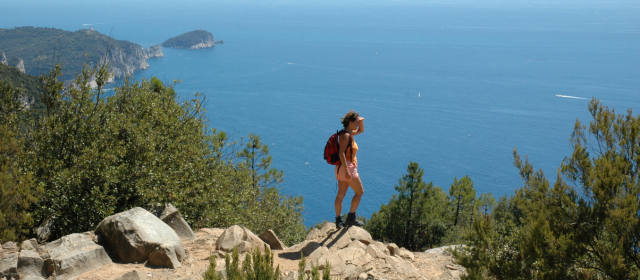
A difficulty rating describes the route as it exists on the map. The experience of walking it depends on several things that sit outside any grading system.
A 16 km stage in April and the same stage in July are two very different days. Heat slows your pace, increases your water consumption, and adds genuine physical strain to what the numbers suggest is a moderate effort. On exposed southern routes, stages that look manageable on paper can feel considerably harder during the hottest months.
If you are travelling in July or August, look particularly carefully at the exposure, shade and water availability on each stage, and consider whether an easier itinerary or a shorter-stage version would make the journey more enjoyable.
A stage that feels comfortable on day one may feel very different after several consecutive days of walking. The legs that moved easily on the first morning carry a different kind of tiredness by the middle of the week, and that changes how the same terrain registers.
Training on consecutive days before departure can help build fitness while also giving you a better idea of how your body responds to repeated effort. The first walking trip checklist covers this in practical detail.
Long or steep descents can be surprisingly demanding, particularly on the knees and on loose or uneven terrain. It is worth looking at both ascent and descent when reading a stage profile, rather than focusing only on the climbing.
Carrying your full luggage naturally changes the physical demands of a stage. On SloWays itineraries where luggage transfer is included, you walk with only your daypack while your main bag is transported to the next accommodation, which makes a noticeable difference over several consecutive days.
The most useful question to ask yourself is not "how fit am I?" but "what does my walking actually look like right now?"
A few practical questions can help:
Can you walk for three to four hours comfortably, with breaks, without significant discomfort the next day?
Have you walked on consecutive days recently, even just on weekends?
Are you comfortable on uneven ground, loose gravel, or paths with some incline?
Would you be comfortable navigating with a phone app on an unfamiliar route?
Your answers give you a useful starting point when comparing itinerary descriptions and difficulty levels. If several of these situations feel unfamiliar, beginning with an easier itinerary gives you more space to enjoy the experience rather than focus on the physical effort.
Choosing a level that feels almost too manageable on paper often turns out to be exactly right in practice. You arrive at each overnight stop with energy left. The walk becomes something you inhabit rather than endure.
There is also everything that happens around the walking itself: the village you have time to explore, the dinner you enjoy without exhaustion, the swimming stop you would have skipped if you were already behind schedule. A well-chosen difficulty level makes room for all of that.
This is something the SloWays team considers carefully when helping people choose their first itinerary. The first walking holiday in Italy guide covers this in more detail, with practical guidance on what easy and moderate stages actually feel like on the ground.
Several of the most popular walking routes in Europe are available in more than one version. The same destination, the same landscapes, and many of the same overnight stops, but with shorter stages, transfers on the most demanding sections, or extra nights built in to reduce the daily distances.
Choosing an easy version does not mean seeing less. Often, it simply means giving yourself more time between one place and the next. They are simply another way of walking the same journey, with more time and energy left for everything that happens around the walk itself.
This is particularly useful for travelers who want to walk a specific route, such as the Via Francigena through Tuscany or the St. Francis Way in Umbria, but want more flexibility in how they experience it.
On the Via Francigena difficulty question specifically, the answer depends entirely on which section you walk and how the itinerary is structured. The standard Lucca to Siena route is graded moderate-easy. The easy version covers the same scenery with shorter stages, designed for walkers who want to take their time.
.png)
What does a walking holiday difficulty level mean? A difficulty level gives you an indication of the physical demands of an itinerary, based on factors such as daily distance, elevation and terrain. It describes the overall character of the route, not a single stage.
How do I know which walking holiday level is right for me? Think about the walking you already do comfortably: how many hours, what kind of terrain, and whether you have experience walking on consecutive days. That is a more useful starting point than a general sense of fitness.
Is an easy walking holiday suitable for beginners? Yes. Easy itineraries are designed to offer the full experience of a multi-day walking journey with shorter, more manageable stages. No previous long-distance walking experience is required.
Can I walk the Via Francigena if I am new to walking holidays? Yes, depending on the section and itinerary. Several sections are available in easier versions with shorter stages, making them accessible to first-time walkers.
Does luggage transfer make a walking holiday easier? It makes a practical difference. Walking with only a daypack rather than your full luggage reduces the physical load on every stage, particularly over several consecutive days.
Difficulty ratings are a starting point, not a final answer. They give you the objective shape of a route. The rest of the picture comes from understanding your current walking experience and how factors like season and cumulative effort will affect the trip.
If you are still uncertain after reading the itinerary description, the SloWays team can help. The conversation usually starts with a few simple questions about your recent walking, your available time, and the kind of trip you want to have. From there, it is usually straightforward to identify the right level and the right route.
Browse all SloWays itineraries by difficulty, explore self-guided walking holidays across Europe, or get in touch to talk through the options before you book.
 Nominee Best Specialist Tour Operator 2026