

From ancient monasteries hidden in the Apennines to medieval hill towns and olive-covered valleys, the Way of St Francis reveals a quieter side of central Italy. Discover the landscapes, villages and cultural treasures that make this historic walking route so special.
When people think of the Way of St Francis, Assisi is usually the first place that comes to mind. With its magnificent basilica, medieval streets and extraordinary artistic heritage, the Umbrian town is undoubtedly one of the most important destinations along the route. But some of the most memorable experiences of the Via di Francesco happen long before you reach Assisi, or after you've left it behind.
The Cammino di San Francesco crosses a remarkable variety of landscapes, from the forested mountains of the Tuscan Apennines to the cultivated hills and valleys of Umbria, continuing south through Lazio towards Rome. Along the way, it connects small villages, ancient sanctuaries, historic towns and rural communities where centuries-old traditions remain part of everyday life.
What makes this journey particularly interesting is the relationship between these places. Rather than travelling from one famous attraction to another, you discover how the landscape changes gradually, how towns developed around important religious and commercial routes, and how local identities have been shaped by geography, agriculture and history.
If you're looking for the most beautiful places along the Via di Francesco, here are some of the destinations and landscapes that make the journey worth taking.
If you’re looking for inspiration for your next Camino, or want help choosing the itinerary that best matches your needs,
take our quiz at the link below!

High in the Tuscan Apennines, surrounded by dense beech and fir forests, the Sanctuary of La Verna is one of the most atmospheric places associated with the life of St Francis.
Built on a rocky mountain outcrop, the sanctuary has been an important Franciscan pilgrimage destination for centuries. According to tradition, Francis received the stigmata here in 1224, an event that established La Verna as one of the most significant sites in Franciscan history.
Yet the experience of visiting La Verna extends far beyond its religious importance.
The complex seems to emerge naturally from the surrounding mountain landscape, with stone buildings, quiet courtyards and paths disappearing into the woodland. Inside, visitors can admire remarkable glazed terracotta works by Andrea della Robbia and his workshop, while outside, the forest offers a striking contrast between the monumental presence of the sanctuary and the simplicity of the natural environment.
For walkers beginning their journey in this part of Tuscany, La Verna introduces one of the defining characteristics of the route: the close connection between cultural heritage and the landscapes in which it developed.
The surrounding Casentino area is also known for its extensive forests, traditional mountain communities and local food, including cheeses, chestnuts and dishes that reflect the agricultural heritage of the Apennines.

As the route continues through eastern Tuscany, the mountain scenery gradually gives way to the valleys and cultivated landscapes of the Valtiberina, the upper valley of the River Tiber.
This is a particularly rewarding part of Tuscany for travellers interested in discovering places beyond the region's most famous destinations.
Among them is Anghiari, a beautifully preserved medieval town built on a hill overlooking the surrounding countryside. Its historic centre is a maze of narrow streets, stone houses, steep passages and small squares, with views extending across the valley.
Anghiari is also closely associated with the Battle of Anghiari, fought in 1440 between Florentine and Milanese forces and later immortalised in Leonardo da Vinci's famous, unfinished artistic project.
But the town's appeal isn't limited to its history. Walking through its streets reveals a quieter, more intimate side of Tuscany, where artisan workshops, traditional architecture and everyday village life exist alongside an important cultural heritage.
The surrounding Valtiberina is equally interesting. Fields, wooded hills and rural settlements create a landscape that feels distinctly different from the more familiar postcard images of Tuscany, while local food traditions reflect the meeting of Tuscan and Umbrian influences.
Here, the pleasure of walking comes partly from discovering how much character can be found in places that rarely feature on conventional Italian itineraries.

Crossing into Umbria, the Via di Francesco reaches Città di Castello, a historic town in the northern part of the region that offers an intriguing combination of Renaissance architecture, contemporary art and local traditions.
Unlike many Umbrian towns built dramatically on hilltops, Città di Castello lies in the Tiber Valley, giving it a different atmosphere and urban character.
Its historic centre preserves elegant palaces, churches and civic buildings that reflect the town's long cultural and political history. The influence of the Vitelli family, who played a prominent role during the Renaissance, is particularly visible in its architecture.
Art lovers will find another reason to stop here: Città di Castello is the birthplace of Alberto Burri, one of the most important Italian artists of the 20th century. His work can be explored through the collections of the Fondazione Palazzo Albizzini Collezione Burri, housed in two distinctive exhibition spaces.
This unexpected encounter with modern and contemporary art is a reminder that the Via di Francesco is not only a journey through medieval history and religious heritage, but also an opportunity to discover the many cultural identities of central Italy.
The town is also a good place to experience the everyday rhythms of Umbrian life, from its markets and cafés to the local cuisine, where fresh pasta, truffles, mushrooms and seasonal ingredients play an important role.

Few places along the Way of St Francis combine history, architecture and legend as memorably as Gubbio.
Built against the slopes of Mount Ingino, this medieval town is immediately recognisable for its imposing stone buildings and dramatic position overlooking the surrounding valley.
Its historic centre is one of the most impressive in Umbria, with steep streets, monumental palaces and panoramic squares that reveal the town's medieval character. The magnificent Palazzo dei Consoli, overlooking Piazza Grande, is among its most recognisable landmarks.
But Gubbio also holds a special place in the story of St Francis.
According to the famous legend of the Wolf of Gubbio, Francis managed to reconcile a dangerous wolf with the frightened inhabitants of the town, persuading the animal to stop attacking people in exchange for food and care.
Whether interpreted as a religious miracle, a symbolic tale or an expression of Francis's relationship with the natural world, the story remains deeply connected to Gubbio's identity.
The town also has a rich tradition of festivals and community celebrations. One of the most remarkable is the Festa dei Ceri, held every year on 15 May, when enormous wooden structures are carried through the streets and up towards the Basilica of Sant'Ubaldo in a spectacular demonstration of local devotion and collective identity.
For walkers, Gubbio offers the opportunity to discover a place where medieval architecture, Franciscan tradition and contemporary community life remain closely intertwined.
Not every memorable place along the Via di Francesco is a major historic town.
Between Gubbio and Assisi, the route passes through the countryside around Valfabbrica, an area of wooded hills, agricultural landscapes and small settlements that offers a different perspective on Umbria.
Here, the appeal lies less in individual monuments and more in the landscape itself.
The walking route crosses rural paths and stretches of woodland, passing fields, farms and hills that gradually reveal the geography of the region. It's the kind of countryside that encourages you to notice the smaller details: the changing colours of the vegetation, the arrangement of olive groves and cultivated fields, or the way villages appear on distant hillsides.
Valfabbrica also has historical connections with the Franciscan tradition, as part of the network of routes linking Assisi with Gubbio and the surrounding territories.
This section of the journey is particularly representative of what makes long-distance walking different from conventional sightseeing. There may be fewer famous attractions, but the experience of moving through the landscape gradually becomes an attraction in itself.
And after several days on the trail, the approach towards Assisi carries a particular sense of anticipation.
For many travellers, Assisi represents the natural conclusion of a pilgrimage. But continuing south reveals some of the most beautiful landscapes and towns along the entire Via di Francesco.
One of the first is Spello, a small Umbrian town famous for its flower-filled streets, beautifully preserved historic centre and extraordinary position overlooking the surrounding countryside.
Built on the slopes of Mount Subasio, Spello has Roman origins that remain visible in its ancient gates, walls and architectural remains. Its medieval streets wind between stone houses, small churches and terraces overlooking the valley.
The town is particularly famous for its Infiorate, elaborate floral carpets created by local residents for the celebration of Corpus Christi. The tradition transforms the streets into temporary works of art made from thousands of flower petals, reflecting a remarkable combination of craftsmanship, religious heritage and community participation.
But Spello is worth visiting at any time of year.
Inside the Church of Santa Maria Maggiore, the Baglioni Chapel preserves magnificent frescoes by Pinturicchio, offering another example of the artistic treasures found in the smaller towns of Umbria.
Beyond the historic centre, the surrounding hills are covered with olive groves that produce some of the region's celebrated extra virgin olive oil.
Spello is a wonderful place to appreciate how art, agriculture, architecture and local traditions can come together to create a distinctive sense of place.

Further south, Spoleto offers another fascinating chapter in the cultural journey along the Way of St Francis.
The town has a long and complex history, with Roman, medieval and Renaissance influences visible throughout its historic centre. Its streets climb towards the imposing Rocca Albornoziana, the fortress that dominates the town, while the magnificent Cathedral of Santa Maria Assunta stands at the heart of one of Umbria's most beautiful architectural settings.
Spoleto is also internationally known for the Festival dei Due Mondi, an important performing arts festival that has brought music, theatre, dance and international artists to the town since 1958.
This combination of ancient heritage and contemporary cultural life makes Spoleto particularly interesting for travellers who enjoy discovering how historic places continue to evolve.
The surrounding landscape adds another dimension to the experience. Hills, forests and olive groves extend beyond the town, while the famous Ponte delle Torri, a monumental bridge-aqueduct, illustrates the dramatic relationship between Spoleto's architecture and its natural setting.
For those walking the section from Assisi to Spoleto, the journey brings together some of the most characteristic elements of Umbria: medieval towns, cultivated landscapes, important artistic treasures and a strong connection to local traditions.
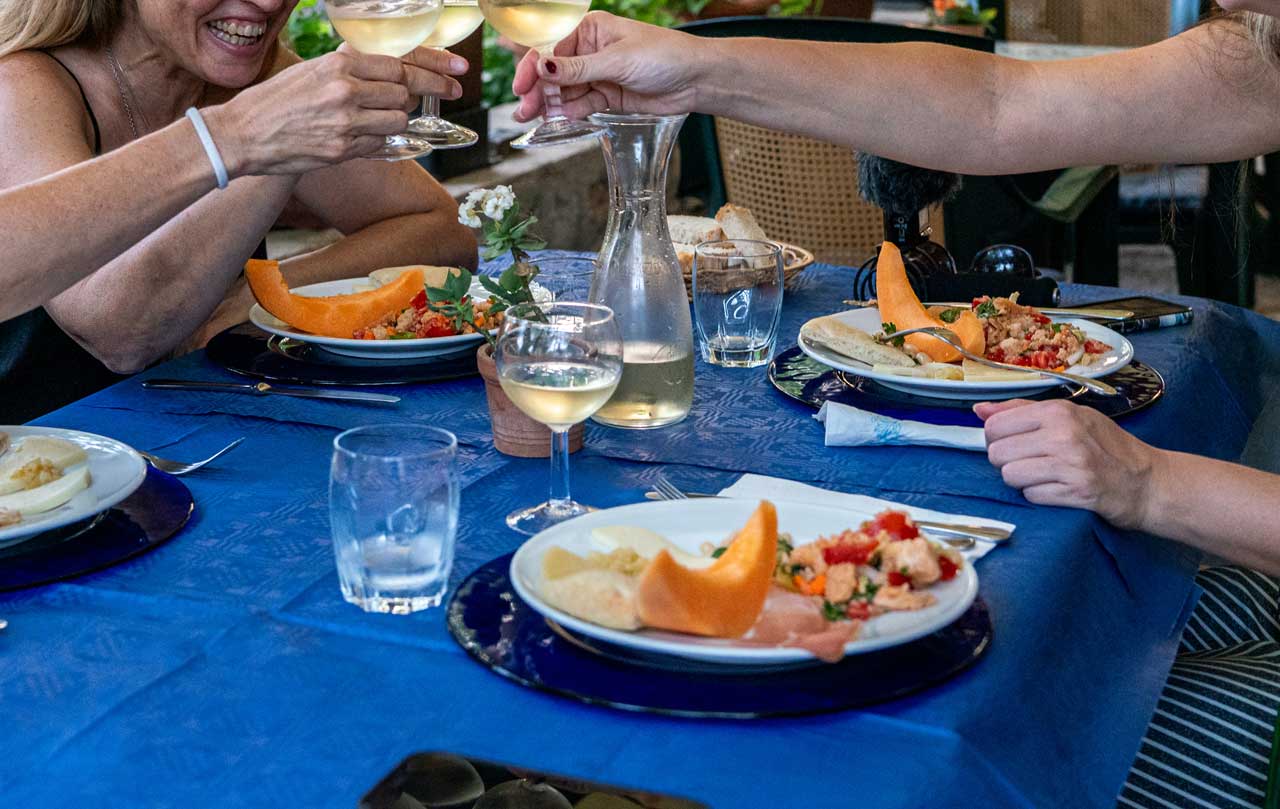
One of the pleasures of travelling slowly through Tuscany and Umbria is the opportunity to discover how local food reflects the landscapes and communities you encounter.
Along the Via di Francesco, gastronomy is closely connected to agriculture, seasonal ingredients and traditions that have developed over generations.
In the Tuscan Apennines and Valtiberina, you'll find dishes shaped by mountain and rural life, including soups, handmade pasta, local cheeses, chestnuts and mushrooms. As the route enters Umbria, olive oil becomes an increasingly important presence, alongside legumes, cereals, cured meats and traditional pasta dishes.
Specialities such as strangozzi, a type of long handmade pasta often served with tomato or truffle-based sauces, offer a taste of the region's culinary identity. In towns such as Spello and Spoleto, locally produced extra virgin olive oil is an essential ingredient, reflecting the centuries-old cultivation of olive trees across the surrounding hills.
Food also provides opportunities to encounter the people who live along the route. A small restaurant, a village bakery or a local food shop can offer an introduction to traditions that might otherwise remain invisible to visitors.
And after a day of walking, even the simplest meal can become one of the most enjoyable moments of the journey.
Discovering a territory through its food is another way of understanding the relationship between landscape, history and everyday life, and the Via di Francesco offers plenty of opportunities to do just that.
There are many ways to explore Tuscany and Umbria, but travelling on foot offers a particularly rewarding perspective.
The Via di Francesco doesn't simply connect beautiful destinations. It reveals the spaces between them, allowing walkers to experience the gradual transitions from mountain forests to river valleys, from cultivated hills to medieval towns.
You begin to understand why villages developed where they did, how agricultural traditions shaped the countryside and how religious and cultural history became embedded in the landscape.
This is also what makes the route appealing to travellers who want to discover a less familiar side of Italy. While places such as Assisi attract visitors from around the world, many of the smaller towns and rural areas along the trail remain relatively overlooked by international tourism.
At SloWays, our self-guided walking holidays along the Via di Francesco are designed to help you explore these territories at your own pace, with carefully planned routes, selected accommodation, luggage transfers and support along the way.
You can choose to walk through the forests and medieval towns between Chiusi della Verna and Assisi, explore the Umbrian landscapes between Assisi and Spoleto, or discover other sections of this remarkable long-distance route.
Because the beauty of the Way of St Francis doesn't belong to a single destination. It's found in the variety of places, landscapes and communities that make up the journey, and in the opportunity to discover them one step at a time.
Discover SloWays walking holidays along the Via di Francesco
Written by the SloWays Team
 Nominee Best Specialist Tour Operator 2026


