

Forests, limestone peaks, medieval villages and views stretching all the way to the sea: discover the mountains that reveal a different Sicily.
A walking holiday in Sicily's Madonie Mountains reveals a side of the island far removed from its famous beaches and volcanic landscapes. In northern Sicily, the Madonie combine mountain trails, exceptional biodiversity and medieval villages. A self-guided journey from Petralia Sottana towards Cefalù brings together rural traditions, panoramic walking and the Mediterranean coast.
There is a moment, travelling through Sicily, when the island seems to change character entirely.
The familiar Mediterranean landscape gives way to wooded slopes, rocky summits and villages perched high above the valleys. The air feels different, the views stretch further, and the sea, although never impossibly far away, seems to belong to another world.
These are the Madonie Mountains, one of Sicily's most remarkable and perhaps least expected landscapes.
For travellers who associate the island primarily with ancient temples, volcanic scenery and long summer afternoons by the sea, discovering the Madonie can feel like encountering a different destination altogether.
Yet these mountains are an essential part of Sicily's identity. Their forests, villages and agricultural traditions tell a story of the island that is just as compelling as the one found along its coastline.
And walking is one of the most rewarding ways to discover it.
If you’re looking for inspiration for your next Camino, or want help choosing the itinerary that best matches your needs,
take our quiz at the link below!

The Madonie Mountains are located in northern Sicily, east of Palermo, within a protected landscape that extends from the mountainous interior towards the Tyrrhenian coast.
Much of the territory belongs to the Madonie Regional Natural Park, established in 1989 to protect the area's exceptional natural heritage.
The mountain range includes Pizzo Carbonara, which reaches approximately 1,979 metres and is one of Sicily's highest peaks.
But the Madonie are not simply a collection of mountains. They form a remarkably varied landscape where limestone formations, forests, agricultural valleys and historic settlements exist within a relatively compact area.
At higher elevations, the scenery can feel almost alpine. Lower down, the landscape gradually changes into olive groves, cultivated hillsides and Mediterranean vegetation.
This variety makes the region particularly interesting for walking, as each stage introduces a different environment.
The Madonie are also recognised as a UNESCO Global Geopark, reflecting the geological importance of the territory and the relationship between its natural heritage and local communities.
The Madonie are among Sicily's most important areas for biodiversity.
Their varied geology, altitude and climate have created an extraordinary range of habitats, from Mediterranean woodland to mountain forests and rocky environments.
The landscape changes with the seasons, and walking here means discovering an island that can be unexpectedly green, wooded and rich in wildlife.
One of the most fascinating features of the Madonie is the diversity of their vegetation.
Beech and oak forests occupy parts of the mountain landscape, while lower elevations support Mediterranean woodland and agricultural environments.
The region is also home to the Sicilian fir (Abies nebrodensis), one of the rarest trees in Europe.
This critically endangered species survives naturally only in a small area of the Madonie, where conservation efforts aim to protect its remaining wild population.
It is an extraordinary example of how the mountains preserve fragments of Sicily's natural history that have disappeared elsewhere.
The park also supports a rich variety of birdlife and other animals, although wildlife sightings are never guaranteed.
For walkers, this biodiversity adds another dimension to the journey. A forest is no longer simply a beautiful place to pass through, but part of a complex environment shaped by geology, climate and centuries of interaction with local communities.
The Sicilian fir's remaining natural habitat is a protected conservation area, rather than a guaranteed stop on the SloWays walking itinerary.
Perhaps the most surprising aspect of the Madonie is the relationship between the mountains and the Mediterranean.
On clear days, viewpoints reveal the rolling countryside of central Sicily, the distant outline of Mount Etna and, further north, the Tyrrhenian Sea.
From certain elevated sections, it may even be possible to see the Aeolian Islands on the horizon.
This creates an unusual sense of geography. You might spend the morning walking through mountain landscapes and, a few days later, find yourself beside the sea.
The transition is gradual, and that is part of its appeal.
Rather than travelling directly from one destination to another, you experience the changing landscape step by step, noticing how the vegetation, architecture and atmosphere evolve as you descend towards the coast.

The villages of the Madonie are as important to the walking experience as the mountains themselves.
Built on hillsides and rocky ridges, many have preserved medieval streets, historic churches and architectural features that reflect centuries of Sicilian history.
They are also living communities, where agricultural traditions, local food and everyday routines remain closely connected to the surrounding landscape.
Petralia Sottana is a particularly atmospheric place to begin a journey through the Madonie.
Set in the southern part of the mountain range, the village offers views across the surrounding countryside and a historic centre of stone buildings, narrow streets and churches.
It is a place that invites exploration before the walking begins.
A stroll through the village reveals the quieter rhythm of mountain life, while the surrounding hills provide an introduction to the landscapes that define the region.
From Petralia Sottana, walking routes lead through rural terrain, with panoramic views towards the Sicilian interior and, in favourable conditions, Mount Etna.
It is an ideal introduction to a side of Sicily that feels very different from its coastal towns.
Gangi is one of the most striking hilltop towns in this part of Sicily.
Its tightly grouped houses rise along the hillside, creating a distinctive silhouette above the surrounding valleys.
Walking through its historic streets reveals a town shaped by centuries of history, with churches, stone buildings and viewpoints that open across the countryside.
Gangi also provides a memorable starting point for a walk towards Geraci Siculo.
The route passes through a traditional rural landscape of rolling hills, old farmsteads and open views, gradually revealing the mountain range ahead.
It is the kind of walk where the journey between villages becomes just as interesting as the villages themselves.
Perched high above the surrounding countryside, Geraci Siculo has a particularly dramatic setting.
Its historic centre preserves traces of its medieval past, including the remains of a Norman castle that once occupied an important strategic position.
The village's elevated location provides wonderful views of the Madonie and the surrounding valleys.
Arriving on foot offers an opportunity to appreciate its relationship with the landscape: the steep approach, the stone streets and the sense of a settlement built to overlook the territory around it.
Geraci Siculo is also the starting point for one of the most panoramic stages of the SloWays itinerary, leading towards Rocca di Gonato.
On clear days, the views may extend towards the coast and the distant Aeolian Islands.
As the route gradually descends towards the coast, Castelbuono introduces another side of the region.
The town developed around the castle of the Ventimiglia family and retains a lively historic centre, with narrow streets, small squares and traditional shops.
It is particularly rewarding to explore after several days of walking through the mountains.
Castelbuono is also known for its food traditions, including local pastries and products associated with the surrounding countryside.
One of the region's most distinctive ingredients is manna, a natural substance obtained from certain ash trees through a traditional harvesting process. Its production is closely associated with the Madonie, particularly the area around Castelbuono and Pollina.
This unusual local speciality is a reminder that the region's culinary identity is inseparable from its landscape.
Here, the pleasure of walking continues at the table, through ingredients and recipes that reflect the history of the territory.
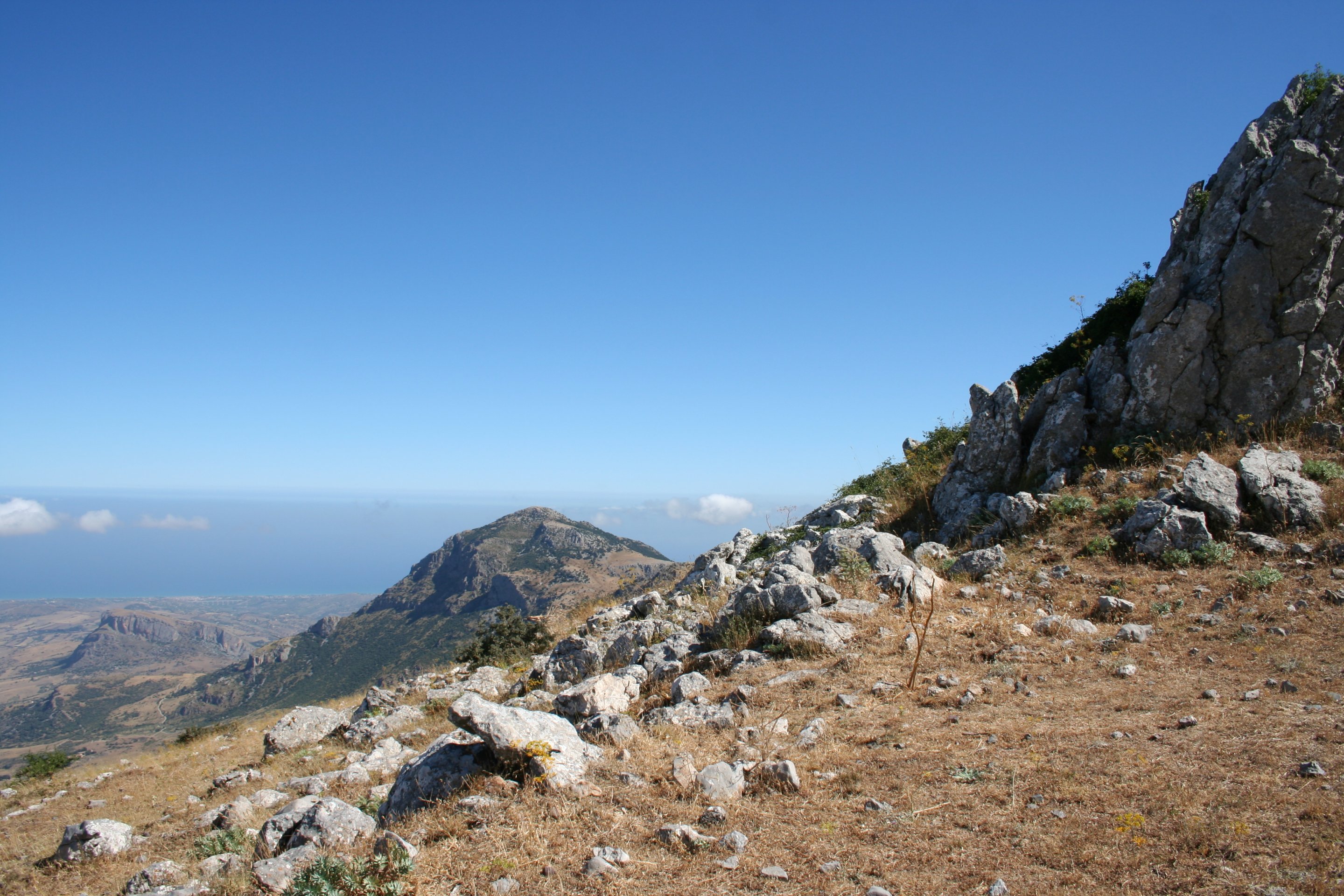
Walking in the Madonie offers a combination of mountain scenery, rural landscapes and historic villages.
The trails are varied, with sections crossing open hillsides, agricultural land, woodland and more rugged mountain terrain.
Unlike a route that follows a single historic path, a walking holiday through the Madonie brings together different landscapes and experiences over several days.
Some stages are particularly panoramic, while others offer a closer encounter with the region's villages and agricultural traditions.
The terrain can be uneven, and certain sections involve steep ascents or descents. In wet weather, clay-rich paths may become slippery or difficult to negotiate.
For this reason, the experience is best suited to travellers who enjoy walking in natural environments and have some familiarity with mountain paths.
The reward is a journey through landscapes that remain relatively unfamiliar to many international visitors.
And perhaps most importantly, the chance to discover a Sicily where the relationship between people and the mountains is still visible in everyday life.

SloWays' Madonie: The Mountains of Sicily is a 7-day, 6-night self-guided walking holiday covering approximately 60 kilometres.
The journey begins in Petralia Sottana and continues through the mountain landscapes and villages of the Madonie before ending in Cefalù, on the Tyrrhenian coast.
The itinerary combines independent walking with pre-arranged accommodation, luggage transportation and selected transfers, allowing travellers to concentrate on the experience of exploring the region.
The first walking day is a 15-kilometre circular route around Petralia Sottana, offering panoramic views of the southern Madonie and the Sicilian interior.
The following morning, a transfer takes travellers to Gangi, where a 12-kilometre walk leads to Geraci Siculo through rural landscapes, traditional farmsteads and rolling hills.
From Geraci Siculo, the route continues towards Rocca di Gonato, covering approximately 15 kilometres and offering some of the journey's most memorable mountain and coastal views.
The next stage descends towards the countryside around Castelbuono, with approximately 12.5 kilometres of walking.
These days provide the heart of the mountain experience, combining panoramic trails with time in some of the region's most interesting villages.
One of the most satisfying aspects of the itinerary is the contrast between its beginning and end.
After several days in the Madonie, the journey concludes in Cefalù, one of Sicily's most beautiful coastal towns.
A transfer and public bus connection bring travellers from the Castelbuono area to the coast, where a short 3-kilometre walking route offers an opportunity to explore Cefalù.
The town is famous for its Norman Cathedral, whose magnificent Byzantine mosaics form part of the UNESCO-listed Arab-Norman heritage of Palermo, Monreale and Cefalù.
Beyond the cathedral, Cefalù offers a historic centre of narrow streets, a picturesque waterfront and a long sandy beach.
For travellers who still have energy to spare, the Rocca overlooking the town provides another perspective on the coastline.
And after several days of mountain walking, the possibility of a swim in the Mediterranean feels like a particularly satisfying conclusion.
The journey from mountains to sea is more than a change of scenery. It brings together two very different expressions of Sicily within a single holiday.
The SloWays itinerary includes:
Travel to Petralia Sottana and onward travel from Cefalù are not included, although additional transfers can be arranged on request.
The itinerary is particularly appealing to travellers who want to experience Sicily's countryside and villages independently, while having the practical arrangements taken care of.
The SloWays Madonie itinerary has a Level 2 difficulty rating, but it is important not to confuse this with a completely easy walking holiday.
The route includes mountain paths, uneven terrain and sections with significant elevation changes.
For example, the walk from Geraci Siculo to Rocca di Gonato involves approximately 433 metres of ascent and 677 metres of descent, while the following stage towards Castelbuono includes a descent of around 728 metres.
These figures are worth considering, particularly for travellers who find downhill walking demanding.
The holiday is suitable for people accustomed to regular walking who have some experience on mountain trails.
It is not recommended for travellers with vertigo or significant stability difficulties, as certain sections may feel exposed or require careful footing.
Sturdy walking boots, trekking poles and appropriate clothing are strongly recommended.
For walkers who enjoy varied landscapes but do not necessarily want a highly demanding mountain expedition, the Madonie can offer a rewarding balance of challenge, cultural discovery and time outdoors.
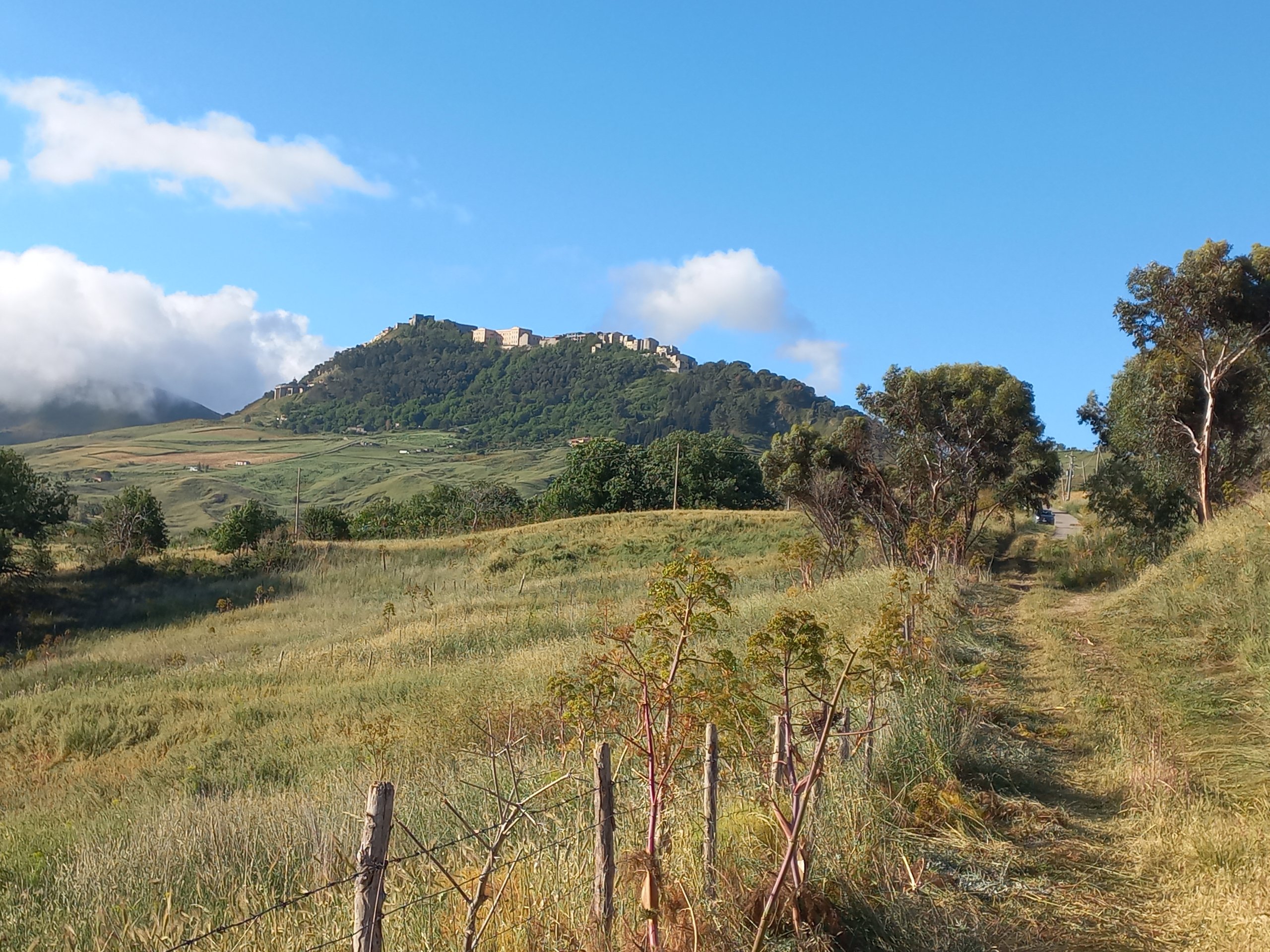
Spring and autumn are particularly appealing seasons for hiking in the Madonie, although the region offers different experiences throughout the warmer months.
In April, May and June, the countryside is often green, with flowering vegetation and generally comfortable walking temperatures.
September and October can also be excellent choices, offering softer light and pleasant conditions for exploring the mountains.
SloWays currently offers departures in April, May, June, July, September and October.
Because the Madonie are a mountain environment, weather conditions can differ considerably from those along Sicily's coast.
Even during warmer months, temperatures may fall at higher elevations, and rain or wind can change walking conditions quickly.
It is therefore important to pack suitable layers and waterproof clothing, rather than relying entirely on Sicily's reputation for sunshine.
The Madonie Mountains are in northern Sicily, east of Palermo, extending from the island's mountainous interior towards the Tyrrhenian coast. Much of the area is protected within the Madonie Regional Natural Park.
Yes. The Madonie offer varied walking routes through mountain scenery, rural landscapes and historic villages. The terrain ranges from relatively gentle paths to more demanding mountain sections.
Pizzo Carbonara is the highest peak in the Madonie Mountains, reaching approximately 1,979 metres above sea level.
Yes. SloWays offers a self-guided walking holiday with route information, navigation support, pre-booked accommodation and luggage transportation. Some mountain walking experience is recommended.
The itinerary is rated Level 2 and covers approximately 60 kilometres over seven days. It includes uneven terrain and substantial ascents and descents, so it is best suited to walkers with some mountain experience.
Yes. The SloWays itinerary ends in Cefalù, where travellers can explore the historic centre, visit the Norman Cathedral and enjoy the Mediterranean coast after several days in the mountains.
There is something particularly memorable about discovering a place that challenges your expectations.
Sicily is often imagined through its coastline, its ancient cities and the unmistakable silhouette of Mount Etna. Yet the Madonie reveal another island entirely.
Here, forests grow across mountain slopes, medieval villages overlook wide valleys, and the landscape preserves extraordinary examples of natural and cultural heritage.
Walking through these mountains offers an opportunity to understand Sicily from a different perspective, one shaped by rural traditions, local communities and the slow transition from highland landscapes to the Mediterranean coast.
And when the journey finally reaches Cefalù, with the sea stretching out beyond the town, the contrast makes both landscapes feel even more remarkable.
Discover SloWays' Madonie Mountains walking holiday and explore Sicily's unexpected wild side, from its mountain villages to the Mediterranean Sea.
Written by the SloWays Team
 Nominee Best Specialist Tour Operator 2026


