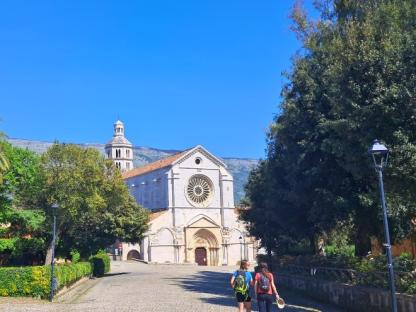
Hikers walking through wildflowers in the countryside on the Via Francigena in Salento

Via Francigena in Salento

Lecce to Santa Maria di Leuca

LEVEL
2
DISTANCE
87 km
DURATION
8 days | 7 nights
PERIOD
Mar Apr May Jun Jul Aug Sep Oct
PRICE FROM
€ 893
CO2e FOOTPRINT
124 Kg/person
  1. Italy
  2.  | 
  3. Hiking Tours
  4.  | 
  5. Tourcode ITSW545

Step into the soul of southern Italy on the Via Francigena in Salento from Lecce to Finisterre, a walking journey where ancient pilgrimage routes meet the wild beauty of the Salento.

This unique journey follows the final stretch of the Via Francigena in Salento, the historic path once walked by pilgrims heading toward the finis terrae — the “end of the land” — at Santa Maria di Leuca. Your adventure begins in Lecce, the baroque heart of Puglia, and leads you inland through Martano, crossing a quiet, authentic countryside shaped by centuries of faith and tradition along this southern Via Francigena walking route.

From there, the route opens toward the sea, reaching Otranto, Italy’s eastern gateway, where history, light, and turquoise waters converge. Walking south along the coast, the Via Francigena Finisterre reveals its most dramatic side: rugged cliffs, hidden coves, and endless horizons as you pass through Marittima, Tricase, and Gagliano del Capo.

The journey culminates in Santa Maria di Leuca, where the Adriatic and Ionian seas meet — a powerful and symbolic destination for pilgrims and walkers alike. After completing this final chapter of the Via Francigena in Salento, you’ll return comfortably to Lecce, enriched by landscapes, stories, and the slow rhythm of the Mediterranean.

Highlights

  • Walk the Via Francigena of the SouthFinisterre, following the ancient pilgrimage route to the very edge of Italy.
  • The buzzing city of Lecce, with its baroque palaces, delicious food and artisan shops 
  • Fabulous walks along the “Tratturi”, ancient roads, through orchards and olive groves  
  • Walk between the Adriatic and Ionian Seas, through cliffs, coves, and endless Mediterranean horizons.
  • Small, comfortable, family run accommodations with delicious culinary specialities 

Itinerary

Day 1

Arrival in Lecce

Arrival in Lecce

Arrive in the Baroque masterpiece of southern Italy, Lecce has a lovely historic center (Centro storico), you can easily spend a day exploring its picturesque little lanes and discovering its treasure: the architecture and the Baroque churches. This lovely town will charm you with its attractive countryside, seashore and small towns close to it.

Day 2

Transfer to Cannole or Martano and walk to Otranto, 22 or 30 km

Transfer to Cannole or Martano and walk to Otranto, 22 or 30 km

The journey begins in Martano, one of the cultural hearts of Grecìa Salentina, where Greek traditions and language still linger. Leaving the town, the path winds through olive groves, dry-stone walls, and quiet country lanes typical of the Salento countryside. As you approach the coast, the landscape opens up and the air becomes saltier. The final stretch leads downhill toward Otranto, dramatically perched above the Adriatic Sea. The arrival is memorable: ancient walls, the Aragonese Castle, and the magnificent Cathedral of Santa Maria Annunziata, home to the famous mosaic floor. Otranto’s historic center is an ideal place to rest, reflect, and enjoy fresh seafood by the sea. 

Distance: 22 or 30 km

Elevation Gain: +150/-235 m

Day 3

Walk from Otranto to Uggiano la Chiesa, 12 km

Walk from Otranto to Uggiano la Chiesa, 12 km

Leaving Otranto behind, the route initially follows coastal paths with beautiful views of cliffs and turquoise waters. Soon, the trail turns inland, returning to a quieter rural atmosphere of farmland and olive trees.You pass small chapels and traces of ancient pilgrimage routes before reaching Uggiano la Chiesa, a peaceful village with a strong spiritual heritage. The Crypt of Santa Maria di Leuca del Belvedere, with its medieval frescoes, is a highlight and a reminder of the deep religious roots of this land. This is a short stage, perfect for a slower pace and cultural exploration. 

Distance: 12 km

Elevation Gain: +160/-100 m

Day 4

Walk from Uggiano la Chiesa to Marittima, 16 km

Walk from Uggiano la Chiesa to Marittima, 16 km

This longer stage crosses the interior of the Salento peninsula. The walk alternates between country roads, paths through olive groves, and small rural settlements. You pass near Giurdignano, known as the “garden of megaliths,” with its menhirs and dolmens scattered across the fields. As you continue south, the terrain becomes more undulating. The approach to Marittima, a hilltop village overlooking the Adriatic, offers sweeping views of the sea. The town retains a strong local character, with narrow streets and traditional architecture, making it a welcoming stop after a demanding day. 

Distance: 16 km 

Elevation Gain: +100/-90 m

Day 5

Walk from Marittima to Tricase, 11 km

Walk from Marittima to Tricase, 11 km

A relatively short and gentle stage. Leaving Marittima, the path descends toward the coast and follows quiet roads through olive groves and small hamlets. The proximity to the sea is felt in the light, the vegetation, and the breeze. 

Distance: 11 km

Elevation Gain: +100/-95 m

Day 6

Walk from Tricase to Gagliano del Capo, 12 km

Walk from Tricase to Gagliano del Capo, 12 km

This stage continues south through the deep Salento countryside, passing stone farmhouses (masserie), fig trees, and dry-stone walls. The route is quiet and reflective, ideal for walking meditation. As you approach Gagliano del Capo, the land becomes more rugged, hinting at the dramatic coastline nearby. Gagliano has long been a gateway for pilgrims heading to Leuca, and the sense of nearing the journey’s end becomes tangible here. 

Distance: 12 km

Elevation Gain: +95/-55 m

Day 7

Walk from Gagliano del Capo to S.Maria di Leuca and train to Lecce, 6,5 km

Walk from Gagliano del Capo to S.Maria di Leuca and train to Lecce, 6,5 km

The final stage is short but emotionally powerful. From Gagliano, you walk toward the southern tip of Puglia, where the Adriatic and Ionian seas meet. The path offers striking views of cliffs, caves, and open sea. The arrival in Santa Maria di Leuca is symbolic and moving. The Sanctuary of Santa Maria de Finibus Terrae (“at the end of the land”) marks the traditional end of the Via Francigena del Sud. Standing by the lighthouse, overlooking the vast sea, pilgrims often take time for reflection, gratitude, and closure before concluding their journey. 
At the end of the walk a private transfer will take you back to Gagliano del Capo. Then return by bus or train to Lecce.

Distance: 6,5 km

Elevation Gain: +40/-100 m

Day 8

Arrivederci Via Francigena!

Arrivederci Via Francigena!

The trip and our services end after breakfast unless you have pre-book an extra in night in Rome or other destinations in Italy. 

Details

Included


What is included

  • 7 Nights in double room in **/*** hotels , B&B and agriturismi with breakfast
  • Luggage transportation from hotel to hotel (1 item per person, max 20 kilos, size 65x40x30 cm)
  • Transfer (Transfer to Cannole or Martano)
  • Maps and detailed description of the itinerary in digital form, app
  • Pilgrim Passport
  • Medical and luggage travel insurance
  • 24h phone assistance

What is not included 

  • Transfers to the starting location and from the arriving location of the tour
  • Lunches and dinners, if not otherwise stated
  • Visits and entrance fees - tips
  • Personal expense
  • Possible sojourn taxes
  • Everything that is not mentioned in the "What is included" section.

Optional Services

These services can be added to the ones included in the base price of the tour:

  • Single room supplement
  • Cancellation insurance
  • Transfers to reach the starting location or to leave the arriving location of the tour, which will be quoted on request.
  • Official camino guidebook, shipped to the first hotel
  • Travel documentation in printed form (maps and detailed description of the itinerary), shipped to the first hotel

Classic Hotels


Accommodation on Our Trips

Our adventures feature a variety of accommodations, depending on the location and the type of trip you choose. We carefully select each property, ensuring it is well situated along the route and locally run, so that you receive a warm welcome and enjoy a comfortable, authentic experience.

Your comfort is a priority throughout your travels. Most of our trips include stays in friendly, independent, or family-run hotels, guest houses, and B&Bs. Each accommodation is chosen for its charm, cleanliness, and those personal touches that make you feel at home. Some trips offer more elevated stays that feel like a special treat, while others may include simpler options, such as mountain refuges, particularly in remote areas.

Classic Hotels – Comfort with Character

Most of our trips combine a variety of accommodation styles to suit the route and location. You will typically stay in charming, locally owned B&Bs, guest houses, inns, and small hotels that offer a warm welcome and comfortable surroundings. These properties often feature extra touches such as distinctive regional character, leisure facilities, or renowned local cuisine.

All accommodations feature private ensuite bathrooms unless otherwise specifically noted for mountain huts, refuges, and pilgrim hostels.

On some mountain adventures and selected pilgrimage routes, the experience may also include more basic accommodation, such as mountain huts, refuges, or pilgrim hostels, where ensuite rooms are not always available and shared bathrooms or dormitory-style accommodation may be part of the experience.

While simpler in style, these accommodations are often rich in atmosphere and camaraderie, providing an authentic connection with fellow travellers and the places you visit.

When to travel


Throughout Central-South Italy you can expect temperatures between 10° and 25°C in spring and autumn and up to 35°C in July and August.

Mornings can be chilly but they quickly warm up as the day goes by. Showers are common in early spring and from September on and throughout the autumn, although not every day, and they tend to be either short and intense or prolonged but light. Because you are by the sea, the sea breeze tends to make the long summer days less hot. 
 

Is this for me?


This section of the Via Francigena in Salento continues beyond Rome and is perfect for walkers seeking a wild, less touristy route that challenges and surprises

The route is generally easy in terms of elevation, with low differences in height, even if much of it follows unpaved or country roads. If you love the sea, this is the journey for you: it winds through the inland Salento between Otranto and Gagliano del Capo, combining scenic landscapes, charming villages, and coastal panoramas.

What to bring


Clothing and other items
You will need your regular walking/cycling gear, including some sort of reflective garment. For the evenings, smart outdoor style trousers (or shorts) are invaluable, as are quick-dry t-shirts. These can be washed easily and will dry overnight and still look good for sightseeing or having a drink in town.

Take as little as possible to avoid potentially lugging a heavy suitcase up three flights of stairs at the end of the day. Please be aware that laundromats (“Laverie”) are not common in rural areas, so plan to do handwashing of small items.

Lightweight walking shoes/ trainers
For wearing around towns & villages. They can also be a back-up pair.

Socks & underwear
Take only good quality socks with quick-dry and insulating qualities. Road test them before you go on the trip. Take a suitable quantity of underwear as washing facilities are limited.

Warm jacket, hat, gloves
Bring a fleece, Polartec or warm layers for the evenings especially in spring or autumn; be sure it is totally suitable for your needs.
A fleece jacket which blocks the wind (Wind-stopper) is the most preferable. In the summer months a lightweight jacket is suitable for evenings.
If you are cycling/walking in mountainous or coastal areas, even in the height of summer, the weather can change very quickly and unexpectedly and you should be prepared for fog, mist, rain, snow or hail at any time. Always take an extra layer with you, as well as a warm hat and gloves.

Waterproof jacket & trousers
If you are caught in heavy rain, with good waterproof clothing you should remain dry. Remember that most garments will lose their properties over time. Few will remain waterproof for more than five years and many deteriorate in three years or less. We recommend a rain jacket with a good hood and collar and waterproof or thermal walking/cycling trousers or tights.

Dress code
In general, you should wear suitable clothing when entering a church (in many places, it is considered unacceptable to go inside wearing shorts or a tank-top). We suggest that women carry a shawl to cover up bear shoulders or low-cut tops. It also comes in handy when your shoulders get sunburned!

It is considered inappropriate for men to go without a shirt / T-shirt (other than at the beach).

Trekking poles (adjustable)
Highly recommended. A pair works best, depending on what you are comfortable with. If you suffer from back or knee pain this should be considered essential. Remember to practise walking with your pole(s) on different types of terrain in the months preceding your trip.

Walking boots
The importance of good footwear cannot be stressed enough. Your boots should be sturdy and of good enough quality to handle all types of terrain. Lightweight boots, (cordura/leather boots) which have Gore-Tex or sympatex water-proofing are most suitable for this trip. They should provide good ankle protection and be well broken in. Waxing leather boots regularly prolongs their life.

Walking tops & trousers
We recommend walking trousers and shorts and quick-dry wicking t-shirts. These can be washed easily and will dry overnight and still look good for sightseeing or having a drink in town. Wicking T-shirts are fast drying, keep moisture away from your skin and are available at outdoor stores. You should also bring one pair of loose-fitting trousers to wear in cities and for evenings out, etc. Shorts or zip-off trousers are useful in warmer weather.

Practical info

How to arrive


How to get there:

The closest International Airports to Lecce are Bari and Brindisi Airports. 

How to leave:

The closest International Airports to Lecce are Bari and Brindisi Airports. 

Mobile App


Use the SloWays APP for iOS and Android smart phones in combination with the written documentation provided.

The App has the detailed tracks and maps that you can use offline and without roaming. Thanks to the phone’s internal GPS, you can check your exact position on the map, so you always know exactly where you are. It also helps you self-navigate you way while travelling. More information on how to use the App inside the roadbook documents.

The navigation features include:

  • Offline navigation. Mobile data not required after initial download
  • Accurate GPS tracks
  • Autorotation of the maps
  • Daily route summary and elevation chart
  • Panorama of the track and at street level
  • Alarm and vibration that alerts you in case you go off track.
  • Emergency SMS button with position coordinates
  • Possibility to record and take georeferenced photos of problems on route alerting fellow travelers
  • Hotel information
  • Points of interest along the way
  • Historical background

You may also like:

Wanderlust Nominee Best Specialist Tour Operator 2026
extraSmallDevice
smallDevice
mediumDevice
largeDevice
largeDevice
largeDevice