Walkers on Via Francigena path between Lucca and Siena

Via Francigena: Stage 6, Lucca to Siena

Classic Hotels Selected Hotels
LEVEL
3
DISTANCE
115 km
DURATION
8 days | 7 nights
PERIOD
Apr May Jun Jul Aug Sep Oct Jan Feb Mar Apr May Jun Jul Aug Sep Oct Nov Dec
PRICE FROM
€ 859 € 1.305
CO2e FOOTPRINT
107 Kg/person
  1. Italy
  2.  | 
  3. Hiking Tours
  4.  | 
  5. Tourcode ITSM360

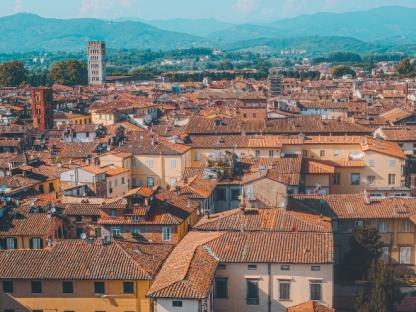
This is one of the most appreciated sections of the whole itinerary, and the reason is not difficult to understand: beautiful Lucca, with its walkable walls, towers surmounted by hanging gardens and the peculiar amphitheatre square, is definitely a great place to start your adventure. 

You then continue through a quintessential Tuscan landscape - cypresses and hills, farmhouses and vineyards, the towers of San Gimignano and those of Monteriggioni, through enchanting riverside parks, gravel roads and quaint hamlets. 

The last step? Among Siena's contrade and into her shell-shaped square, where the world-famous Palio takes place and where pilgrims lay to rest and celebrate the sweet success of a complete journey. 

Highlights

  • A toast at the beginning of the journey in Piazza dell’Anfiteatro in Lucca;
  • Admire the skyline of San Gimignano from the road that leads to Colle val d’Elsa;
  • Stand in silence in the Pieve di Chianni, at Gambassi terme;
  • Enjoy a dish of Pici Cacio e Pepe in the fortified village of Monteriggioni.

Itinerary

Day 1

Lucca

Lucca

Lucca is a town with a charming old town centre, rich in attractions: we advise you to enjoy a long walk along its sixteenth-century walls, admiring the surrounding view, before going to discover why Holm-oak trees grow at the top of the Guinigi tower. Naturally, the mystery can be revealed only by climbing the numerous steps! Restore yourselves with a snack of Bucellato, before visiting the splendid Duomo. After dinner, go and admire the elliptic square built over the ruins of the ancient Roman amphitheatre, now hidden by multi-coloured houses containing little restaurants and artisan shops.

Day 2

From Lucca to Altopascio by train - from Altopascio to San Miniato, 29 km

From Lucca to Altopascio by train - from Altopascio to San Miniato, 29 km

Leaving Altopascio you will walk along a splendid section of the original paved Via Francigena, surrounded by woods. Allow yourself to be charmed by the wild land of the Cerbaie, and enjoy a panoramic view of the old village of Fucecchio from the top of the old park with its ancient medieval tower. After crossing over the river Arno, you will walk along its banks towards San Miniato. The Seminary which gives the name to the main square will amaze you with its particular facade: enjoy it lit up, perhaps after eating a risotto dusted with the typical white truffle, the pride of the local area.

If you think that this stage may be too long for you too walk, don't worry: you can make it shorter by taking brief stretches by public transport. 

Distance: 29 km

Elevation gain: +250/-115 m

Day 3

From San Miniato to Gambassi Terme, 24 km

From San Miniato to Gambassi Terme, 24 km

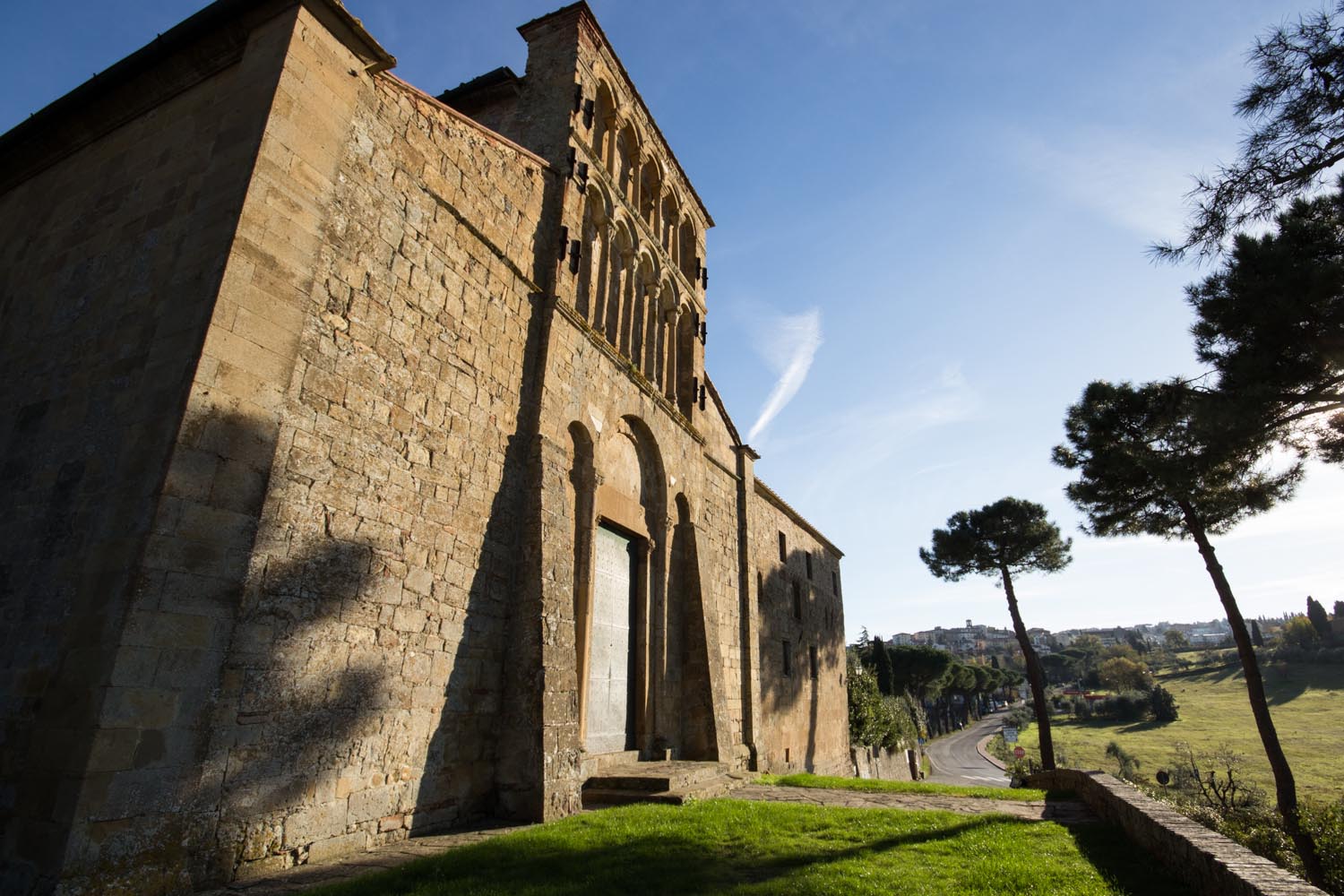
A demanding leg, but one with unique beautiful scenery, awaits you. From San Miniato you will walk along an asphalted section of road, amply compensated by the following part which passes through the splendid crests of the hills of the Val d'Elsa: along the road you can cross the threshold of the Pieve di Chianni, following in the footsteps of entire generations of pilgrims. For a fitting end to the day you can enjoy a healthy bath in the hot springs of Gambassi, surrounded by a park of ancient trees.

Distance: 24 km

Elevation gain: +400/-220 m

Day 4

From Gambassi Terme to San Gimignano, 13,5 km

From Gambassi Terme to San Gimignano, 13,5 km

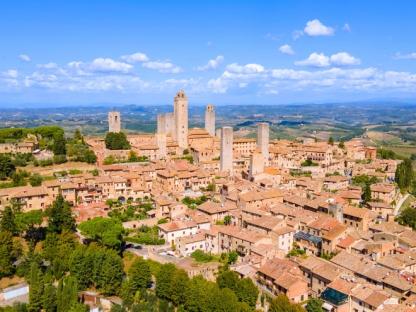
This leg of the journey, short but rich in splendid natural scenery, will lead you to San Gimignano, one of the most beautiful towns along the Via Francigena: you will get a foretaste of your arrival when you see the famous towers that make its skyline unmistakeable. Do not miss the view of the medieval town and its surrounding valleys from the top of the Torre Grossa, or if you don’t run out of energy, venture up the steps of the Rocca di Montestaffoli, for an even more special view. During the evening, take a quiet stroll to admire the illuminated town before enjoying a good glass of Vernaccia in one of the taverns of the old town centre.

Distance: 13,5 km

Elevation gain: +350/-350 m

Day 5

From San Gimignano to Colle Val d'Elsa, 12 km

From San Gimignano to Colle Val d'Elsa, 12 km

From San Gimignano you will continue, up and down, through the Tuscan hills. In one point of the journey not yet well marked you will come to Sce Martin in Fosse, one of the halting places along the ancient route of Sigerico. Today's destination is Colle Val d'Elsa, a Tuscan village which will take you back in time, with its charming old town centre and narrow alleyways winding through the stone walls.

Distance: 12 km

Elevation gain: +287/-222 m

Day 6

From Colle Val d'Elsa to Monteriggioni, 16 km

From Colle Val d'Elsa to Monteriggioni, 16 km

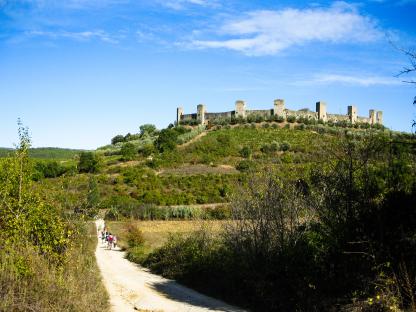
Prepare yourselves for one of the most beautiful sections of the Via Francigena: a meditative route, along which you can admire the Pieve di Strove (unfortunately just from the outside) and stand in the quietness of the splendid Abbadia at Isola, another stage in the journey of the Archbishop Sigerico, where time stopped 1000 years ago, when he passed through. Your breath will be taken away when you see the castle of Monteriggioni, with its crown of towers, built on a hill in order to defend the ancient Republic of Siena. Within it, a small ancient world, with the beautiful square and small gardens where you will be able to gather your breath, before climbing up onto the walls to admire the surrounding view.

Distance: 16 km

Elevation gain: +287/-222 m

Day 7

From Monteriggioni to Siena, 20 km

From Monteriggioni to Siena, 20 km

From Monteriggioni you will start your walk again along the white roads of the Sienese countryside, passing thought the old, no longer inhabited medieval village of Cerbaia: you will experience the same feelings as the ancient pilgrims when you pass through porta Camollia, the traditional Francigena entrance to the town of Siena. An unforgettable way to celebrate? A plate of pici all'aglione in the illuminated Piazza del Campo. And don’t forget the panforte!

Distance: 20 km

Elevation gain: +300/-250 m

Day 8

Siena

Siena

Last day is included. Service ends after breakfast.

Details

Included


What is included

  • 7 Nights in double room in **/*** hotels , B&B and agriturismi with breakfast
  • 2 dinners
  • luggage transportation from hotel to hotel (1 item per person, max 20 kilos, size 65x40x30 cm)
  • official guidebook, App
  • Pilgrim Passport
  • Medical and luggage travel insurance
  • 24h phone assistance

What is not included 

  • Transfers to the starting location and from the arriving location of the tour
  • lunches and dinners, if not otherwise stated
  • visits and entrance fees - tips
  • personal expense
  • possible sojourn taxes
  • everything that is not mentioned in the "What is included" section.

Optional Services

These services can be added to the ones included in the base price of the tour:

  • Single room supplement
  • cancellation insurance
  • Transfers to reach the starting location or to leave the arriving location of the tour, which will be quoted on request.

Classic Hotels


For our trips, we always choose accommodation with private rooms and private bathrooms. In rare cases, shared accommodations or shared bathrooms may be provided, so we recommend carefully checking the inclusions section to understand the type of accommodation included in the trip you are interested in.  

We place great importance on the choice of accommodations and select hotels with care and attention. We understand how essential it is to rest well after a day of walking. We always prefer cozy and characteristic establishments, preferably family-run, that fully embody the spirit of the place and offer hospitality with courtesy and comfort.  

Where, due to the nature of the route, accommodation options are limited, we choose the one that best aligns with our standards.

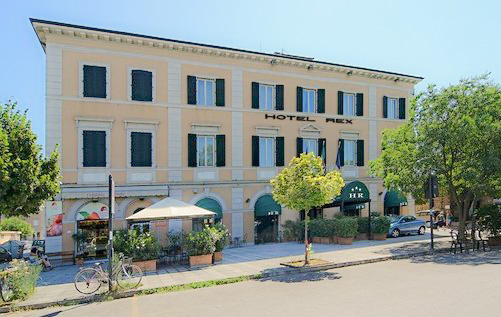
Hotel Rex Lucca
Hotel Rex - Lucca

Hotel Rex*** is 80 m from the main train station and 100 m from the ancient walls of Lucca. Rooms are quiet and well-finished with free Wifi, air conditioned, telephone and fridge. Staff is helpful and courteous. Buffet breakfast is rich and varied. 


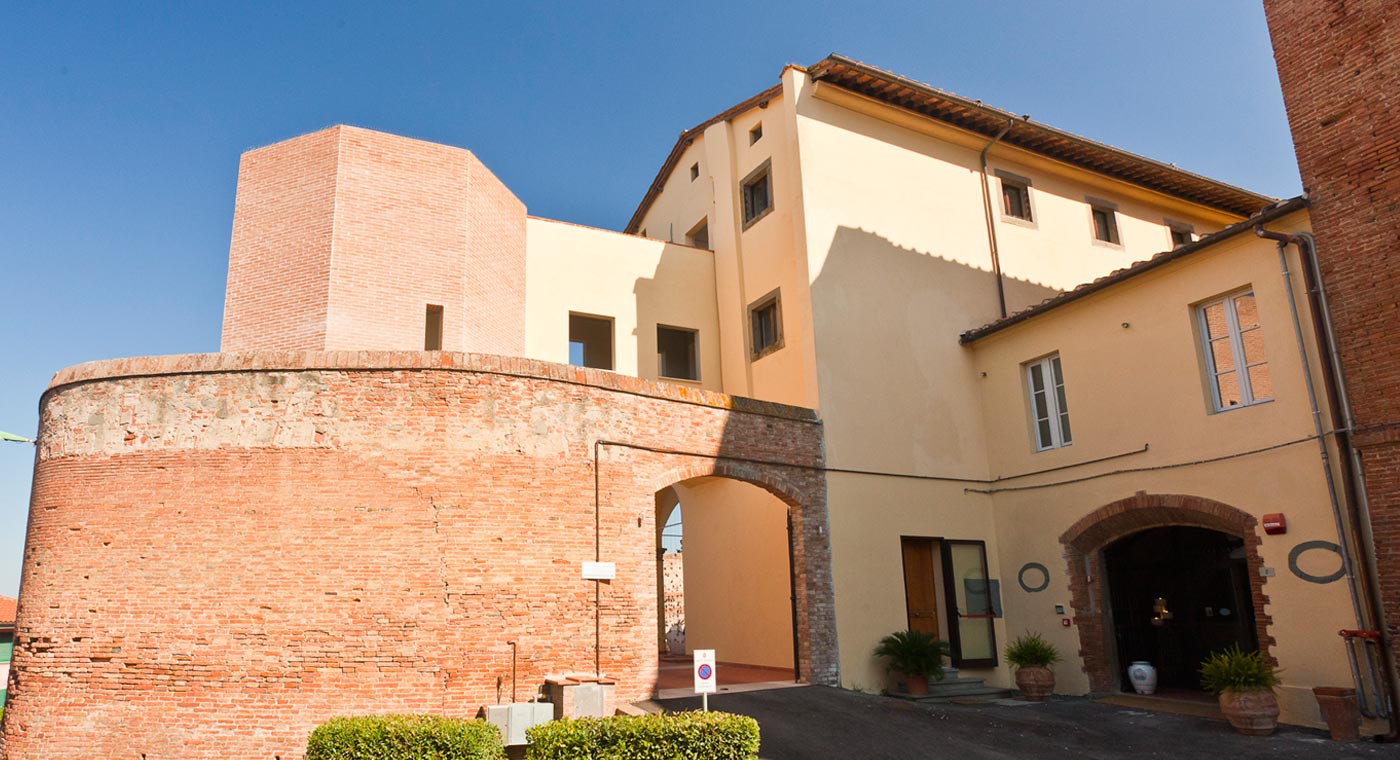
Hotel San Miniato San Miniato
Hotel San Miniato - San Miniato

What in the thirteenth century was a severe monastery cloister is now Hotel San Miniato, refined historic home sits on a hill overlooking the Tuscan countryside between Florence and Pisa. The rooms are comfortable, elegant and clean. Breakfast is good and rich. 


Ostello Sigerico Gambassi
Ostello Sigerico - Gambassi

This building is situated on one of the branches of the Via Francigena, which Sigerico, Archbishop of Canterbury, walked between 990 and 994. This hostel housed in finely restored historical buildings and it has basic, clean and comfortable rooms.


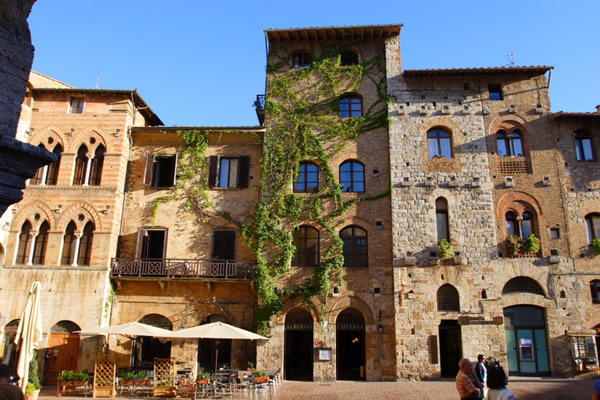
Hotel La Cisterna San Gimignano
Hotel La Cisterna - San Gimignano

The hotel is both overlooking the ancient Piazza della Cisterna used to welcome pilgrims from all over the world and charming hills of San Gimignano. This stately homes is located in an excellent position, into the heart of San Gimignano. 


Arnolfo B&B Colle Val d'Elsa
Arnolfo B&B - Colle Val d'Elsa

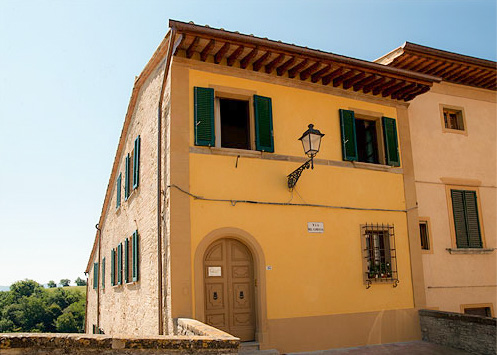
The Arnolfo B&B, next to the ponte di Campana, is a confortable accomodation divided into three apartments for a total of 10 rooms, each having its own bathroom with shower, Wi-Fi and satellite TV. Furthermore these are spacious and quiet. The location is well-finished and beautifully decorated. Breakfast is rich. 

Il Piccolo Castello Monteriggioni
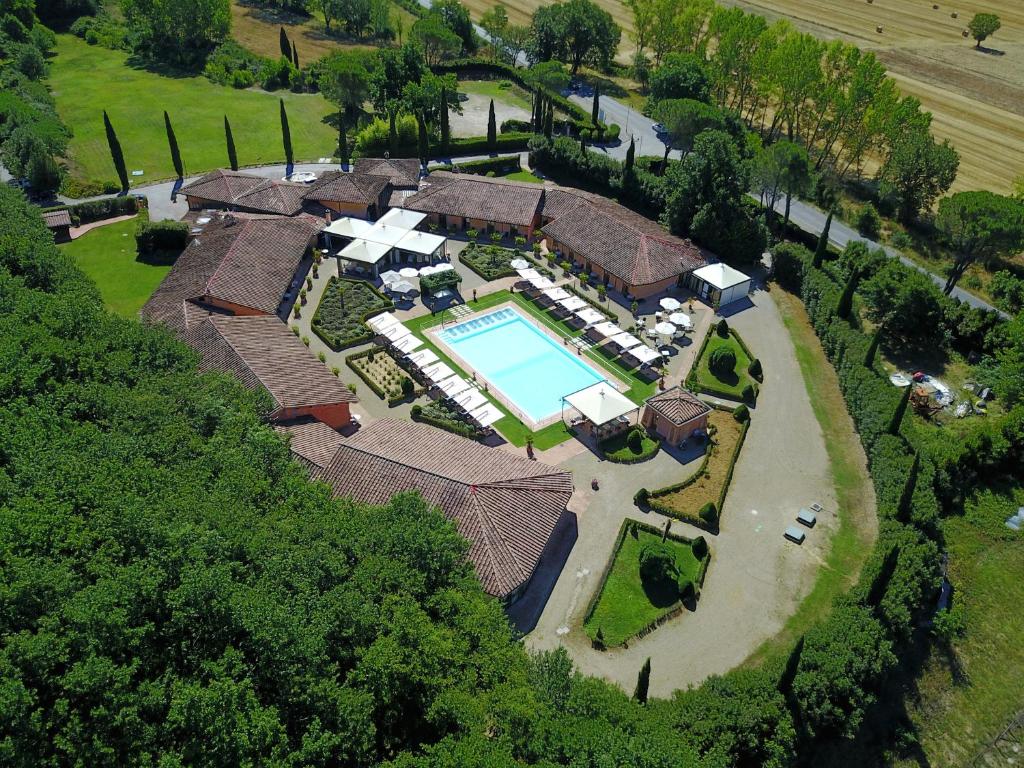
Hotel il Piccolo Castello - Monteriggioni
Hotel Chiusarelli Siena
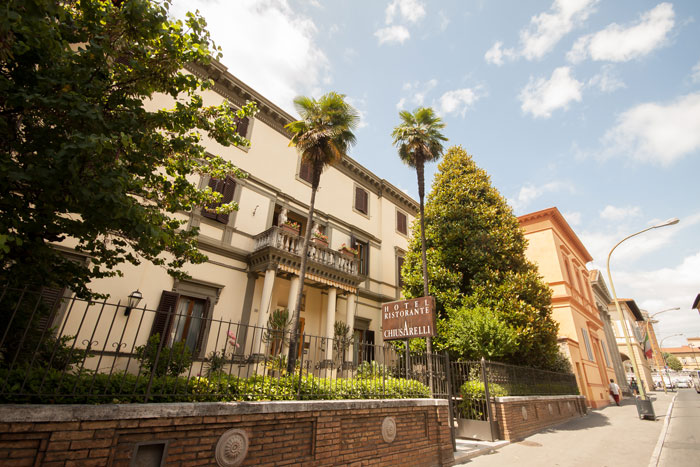
Hotel Chiusarelli - Siena

Hotel Chiusarelli*** is located in the city center of Siena and finds its natural setting in a neoclassical villa built around 1870. The Hotel has been completely renovated in 2013 and offers spacious and clean rooms with air conditioning/heating, telephone, free Wifi and TV with Sky Vision. The Hotel doesn't have the lift. Quality breakfast. 


Selected Hotels


The upgraded accommodations [..]  tbd

When to travel


The climate in Tuscany is generally very mild with differences depending on the geography  of the  region, from coasts and valleys to the continental areas. The warmest months are generally July and August, with temperatures ranging from 23°C up to 30°C; the valleys can often see higher  temperatures and 38°C to 40°C is not uncommon. While June and September offer both nice warm weather. Of course, there are always exceptions or dry spells that cause a few days to get really hot.Spring (April and May) and Autumn (October and November) are dry, with sunny days but the chances of rain are high.The weather can change very quickly and you must be prepared forrain, mist, wind, fog (and even hail or snow at higher elevations) –especially in spring and autumn. 

Is this for me?


One of the most beautiful parts of Via Francigena, from the walls of Lucca to Siena and its contrade. We suggest that you take a train to Altopascio as the itinerary leaves the city of Lucca through an industrial area - we'd like you to set off on the right foot! This is perfect if you'd like to walk and explore some among the most beautiful cities of Tuscany - especially if you add a few extra days to explore the local art and culture! 

What to bring


Clothing and other items
You will need your regular walking/cycling gear, including some sort of reflective garment. For the evenings, smart outdoor style trousers (or shorts) are invaluable, as are quick-dry t-shirts. These can be washed easily and will dry overnight and still look good for sightseeing or having a drink in town.

Take as little as possible to avoid potentially lugging a heavy suitcase up three flights of stairs at the end of the day. Please be aware that laundromats (“Laverie”) are not common in rural areas, so plan to do handwashing of small items.

Lightweight walking shoes/ trainers
For wearing around towns & villages. They can also be a back-up pair.

Socks & underwear
Take only good quality socks with quick-dry and insulating qualities. Road test them before you go on the trip. Take a suitable quantity of underwear as washing facilities are limited.

Warm jacket, hat, gloves
Bring a fleece, Polartec or warm layers for the evenings especially in spring or autumn; be sure it is totally suitable for your needs.
A fleece jacket which blocks the wind (Wind-stopper) is the most preferable. In the summer months a lightweight jacket is suitable for evenings.
If you are cycling/walking in mountainous or coastal areas, even in the height of summer, the weather can change very quickly and unexpectedly and you should be prepared for fog, mist, rain, snow or hail at any time. Always take an extra layer with you, as well as a warm hat and gloves.

Waterproof jacket & trousers
If you are caught in heavy rain, with good waterproof clothing you should remain dry. Remember that most garments will lose their properties over time. Few will remain waterproof for more than five years and many deteriorate in three years or less. We recommend a rain jacket with a good hood and collar and waterproof or thermal walking/cycling trousers or tights.

Dress code
In general, you should wear suitable clothing when entering a church (in many places, it is considered unacceptable to go inside wearing shorts or a tank-top). We suggest that women carry a shawl to cover up bear shoulders or low-cut tops. It also comes in handy when your shoulders get sunburned!

It is considered inappropriate for men to go without a shirt / T-shirt (other than at the beach).

Trekking poles (adjustable)
Highly recommended. A pair works best, depending on what you are comfortable with. If you suffer from back or knee pain this should be considered essential. Remember to practise walking with your pole(s) on different types of terrain in the months preceding your trip.

Walking boots
The importance of good footwear cannot be stressed enough. Your boots should be sturdy and of good enough quality to handle all types of terrain. Lightweight boots, (cordura/leather boots) which have Gore-Tex or sympatex water-proofing are most suitable for this trip. They should provide good ankle protection and be well broken in. Waxing leather boots regularly prolongs their life.

Walking tops & trousers
We recommend walking trousers and shorts and quick-dry wicking t-shirts. These can be washed easily and will dry overnight and still look good for sightseeing or having a drink in town. Wicking T-shirts are fast drying, keep moisture away from your skin and are available at outdoor stores. You should also bring one pair of loose-fitting trousers to wear in cities and for evenings out, etc. Shorts or zip-off trousers are useful in warmer weather.

Practical info

How to arrive


From Pisa Airport (PSA), you can take a train to Lucca with change in Pisa Centrale station.

From Florence Airport (FLR), take a public bus to Florence Santa Maria Novella Train Station, and then a train to Lucca (with change in Pisa Centrale).

On departure, if flying from Pisa airport PSA, you first need to reach Florence by bus. Once in Florence, you need to take a train to Pisa Central Station. From there, you can reach the airport by either bus or train.

As an alternative, you can catch a bus from Siena station to Pisa aiport.

You can also reach Pisa from Siena by train, but you always have to change in Empoli. 

If flying from Florence airport FLR, you first need to reach Florence train station Santa Maria Novella by either bus or train (both direct). Once in Santa Maria Novella, you can reach the airport by either taxi or bus.


Mobile App


Use the SloWays APP for iOS and Android smart phones in combination with the written documentation provided.

The App has the detailed tracks and maps that you can use offline and without roaming. Thanks to the phone’s internal GPS, you can check your exact position on the map, so you always know exactly where you are. It also helps you self-navigate you way while travelling. More information on how to use the App inside the roadbook documents.

The navigation features include:

  • Offline navigation. Mobile data not required after initial download
  • Accurate GPS tracks
  • Autorotation of the maps
  • Daily route summary and elevation chart
  • Panorama of the track and at street level
  • Alarm and vibration that alerts you in case you go off track.
  • Emergency SMS button with position coordinates
  • Possibility to record and take georeferenced photos of problems on route alerting fellow travelers
  • Hotel information
  • Points of interest along the way
  • Historical background

You may also like:

Frequently Asked Questions

Everything You Need to Know Before You Walk

What is the difference between the Classic and the Easy version of this walk?

Both follow the same route, but the Easy version features shorter daily stages, a more relaxed pace, and a few sections covered by local public transport.

The Classic version covers 115 km in 7 stages, with daily distances ranging from 12 to 29 km.

If this is your first long-distance walk or you prefer arriving at your accommodation with plenty of energy left to explore, the Easy version is designed for you.

If you want to walk as much of the route as possible, the Classic version is the right choice.
Daily stages vary considerably, from 12 km on the Gambassi–San Gimignano stage to 29 km on the Altopascio–San Miniato stage.

The average distance is approximately 16–17 km per day.

The longest stages can be shortened by using sections of local public transport, as indicated in the itinerary notes.

No specific hiking experience is required.

However, you should be comfortable walking for several consecutive hours.

The route is graded 3 out of 5: elevation gain is moderate, with a maximum ascent of around 400 metres on the stage to Gambassi Terme, but some days are long and require good endurance.

We recommend preparing with walks of at least 3 to 4 hours during the weeks leading up to your trip.

Yes.

Transfer of one bag per person from hotel to hotel is included in the price.

The maximum allowance is 20 kg, with dimensions not exceeding 65 × 40 × 30 cm.

Each day your luggage will be waiting for you at the next accommodation, while you carry only the essentials in your daypack.

The holiday is completely self-guided.

You will receive a detailed roadbook with directions for every stage.

You can also download our offline GPS navigation app at no extra cost.

The app alerts you if you leave the route and includes an emergency feature that allows you to share your location with our team if needed.

The Via Francigena is also well signposted throughout the route.

Yes, many of our travellers complete this section solo.

The route is safe, well signposted, and passes through villages and towns with services along the way.

Telephone support is available throughout your trip.

If this is your first solo long-distance walk, this is one of the best sections to choose: not too remote, with comfortable accommodation every evening.

April, May, September, and October are generally the best months to walk this section.

Temperatures are mild, the Tuscan countryside is at its most beautiful, and the towns are less crowded.

July and August are still possible but can be very hot, especially on the longer stages.

Winter is generally not recommended because of shorter daylight hours and reduced services at some accommodations.

This section of the Via Francigena passes through some of Tuscany’s richest food regions.

In San Miniato, look out for the famous white truffle, one of Italy’s most prized specialities.

In Monteriggioni, stop for a plate of traditional pici cacio e pepe.

In Siena, celebrate your arrival with pici all'aglione and finish with a slice of traditional panforte.

Lunches are not included, but there are plenty of trattorias, bakeries, and cafés along the route.

Lucca is easily reached by train from Florence (around 1 hour 20 minutes) or Pisa (around 30 minutes).

Siena is connected to Florence by coach or train.

There is no need to rent a car, as both cities are well served by public transport.

Up-to-date timetables are available through local rail and transport operators.

Yes.

We particularly recommend adding extra nights in San Gimignano and Siena.

San Gimignano is especially atmospheric in the evening after the day visitors have left.

Siena deserves extra time to explore the Duomo, museums, and historic neighbourhoods at a relaxed pace.

We can customise the itinerary to match your interests and schedule.

Yes.

The trip price includes basic medical and luggage insurance.

More comprehensive coverage, including trip cancellation insurance, is available as an optional extra.

We recommend considering it, particularly if you are booking well in advance.


Wanderlust Nominee Best Specialist Tour Operator 2025
Wanderlust
Nominee Best Specialist Tour Operator 2023
SloWays
Change currency:

We accept:

VISA MASTERCARD
SATISPAY

We accept:

VISA MASTERCARD
SATISPAY
FTO
ATTA member
RePower
Travelife
ISO Partner
ISO Partner
FTO ATTA member RePower
Travelife ISO Partner ISO Partner

Touroperating
S-Cape Countryside Travels srl
Borgo Allegri 16R
50122 Firenze FI
P. IVA 05227330486

 
© 2026 SloWays. All rights reserved.
Touroperating S-Cape Countryside Travels srl Borgo Allegri 16R 50122 Firenze FI, Italy
VAT Nr 05227330486
extraSmallDevice
smallDevice
mediumDevice
largeDevice
largeDevice
largeDevice