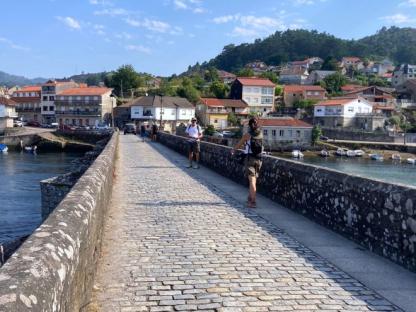
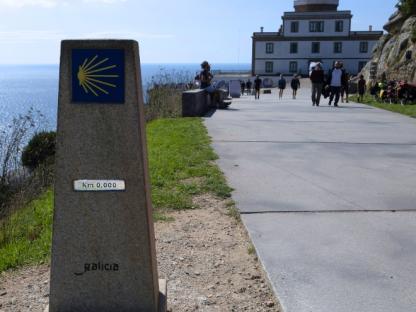
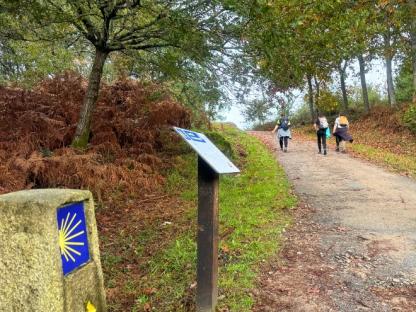
Pilgrims walking along a rural path on the Camino Portuguese near stone waymarkers

Camino Portuguese Backpack

Tui to Santiago

LEVEL
2
DISTANCE
113 km
DURATION
7 days | 6 nights
PERIOD
Mar Apr May Jun Jul Aug Sep Oct
PRICE FROM
€ 335
  1. Spain
  2.  | 
  3. Caminos
  4.  | 
  5. Tourcode VE-12.1

There is something special about walking the final stretch of the Camino Portuguese. Each step carries a sense of anticipation — villages become more animated, pilgrims join from many countries, and the path slowly leads toward Santiago.

Starting in the historic border town of Tui, where Spain meets Portugal along the River Miño, this is the beginning of the classic Camino Portuguese from Tui to Santiago. Over the following days you will cross the green landscapes of Galicia: quiet forests, traditional villages, vineyards and lively historic towns such as Pontevedra and Padrón.

Although shorter than other Camino itineraries, this journey offers a complete pilgrimage experience. Walking the final 100 km to Santiago allows you to enter the rhythm of the Camino and receive the Compostela, the traditional certificate given to pilgrims who reach the cathedral on foot.

In this hostel-based version, you follow an authentic and social Camino Portuguese backpacking route. You stay in privately managed pilgrim hostels, sharing spaces and stories with travellers from around the world — a journey built on walking, encounters and the unique sense of community that has always defined the Camino.

And at the end of the road, the moment every pilgrim remembers: stepping into Praza do Obradoiro, where the cathedral of Santiago finally stands before you.

Highlights

  • Walking the final 100 km of the Camino Portugués to earn the Compostela
  • The historic cathedral-fortress of Tui at the Spanish–Portuguese border
  • Discovering the lively old town of Pontevedra
  • Crossing forests and green countryside typical of Galicia
  • Following the ancient pilgrimage route to Padrón, linked to the legend of Saint James
  • The emotional arrival in Santiago’s Praza do Obradoiro

Itinerary

Day 1

Arrival in Tui

Arrival in Tui

Your journey begins in the historic border town of Tui, located along the River Miño that separates Spain from Portugal. The town’s medieval streets climb toward the impressive cathedral-fortress that dominates the skyline. Pilgrims have crossed this river for centuries before beginning their walk to Santiago. Take time to wander through the old town, enjoy the relaxed atmosphere of Galicia, and prepare for the first day on the Camino.

Day 2

From Tui to Redondela, 31 km

From Tui to Redondela, 31 km

Leaving Tui, the Camino passes through woodland paths, small villages and gentle countryside. Vineyards and farmland shape the landscape as the trail gradually climbs toward the hills of Galicia. The walking alternates between rural tracks and traditional stone villages where daily life unfolds quietly. As you approach Redondela, the Atlantic estuaries come into view. The town itself has long welcomed pilgrims arriving from both inland and coastal routes.

Distance: 31 km

Day 3

From Redondela to Pontevedra, 20 km

From Redondela to Pontevedra, 20 km

Today’s stage follows peaceful rural paths and shaded woodland trails. The route gradually leaves the estuary behind and moves deeper into Galicia’s green interior. Small villages appear along the way, offering cafés and resting places for pilgrims. Pontevedra is one of the most charming towns on the Camino Portugués, with a beautifully preserved historic centre, lively squares and elegant stone streets that invite a relaxed evening stroll.

Distance: 20 km

Day 4

From Pontevedra to Caldas de Reis, 22 km

From Pontevedra to Caldas de Reis, 22 km

Leaving Pontevedra, the path winds through quiet countryside dotted with farms and small chapels. The terrain remains gentle and pleasant, with shaded sections and occasional views across green valleys. The route crosses several streams before reaching Caldas de Reis, a historic spa town known for its thermal waters. Pilgrims have paused here for centuries to rest and restore their strength before continuing their journey north.

Distance: 22 km

Day 5

From Caldas de Reis to Padrón, 18 km

From Caldas de Reis to Padrón, 18 km

The Camino continues through forests, small villages and fertile farmland typical of rural Galicia. The walking is peaceful and rhythmic, with gentle climbs and descents along country paths. Padrón is a town deeply linked to the story of Saint James: according to tradition, this is where the boat carrying his remains first arrived in Galicia. Its historic streets and quiet riverbanks make it a meaningful stop before the final stage.

Distance: 18 km

Day 6

From Padrón to Santiago de Compostela, 22 km

From Padrón to Santiago de Compostela, 22 km

The final stage begins among rural paths and villages before gradually approaching the outskirts of Santiago. The excitement grows with every kilometre as more pilgrims join the trail. Soon the spires of the cathedral appear above the rooftops, guiding you into the historic centre. Arriving in Praza do Obradoiro, standing before the magnificent cathedral, is an unforgettable moment — the culmination of your Camino.

Day 7

¡Adiós Santiago de Compostela!

¡Adiós Santiago de Compostela!

Your Camino ends in Santiago, but many pilgrims choose to spend additional time exploring the city. Attend the Pilgrim’s Mass, collect your Compostela certificate, or wander through the medieval streets of the old town. Santiago’s atmosphere invites reflection and celebration before beginning the journey home.

Details

Included


What is included

  • 6 Nights in double room in hostels (common rooms and shared bathroom) with breakfast
  • Maps and detailed description of the itinerary
  • Medical and luggage travel insurance
  • 24h phone assistance

What is not included

  • Transfers to the starting location and from the arriving location of the tour
  • Lunches and dinners, if not otherwise stated
  • Visits and entrance fees - tips
  • Personal expense
  • Possible sojourn taxes
  • Everything that is not mentioned in the "What is included" section.

Optional Services

These services can be added to the ones included in the base price of the tour:

  • Luggage transfers from hostel to hostel
  • Excursion to Costa da Morte (Finisterre and Muxia)
  • Cancellation insurance
  • Pilgrim Passport
  • Transfers to reach the starting location or to leave the arriving location of the tour, which will be quoted on request.
     

Accomodation


What type of accommodation is provided?

The accommodation consists of privately managed hostels (albergues), which generally offer a wider range of services than public pilgrim hostels. You will stay in shared dormitories with 4, 6, 8 or 12 beds.

If you prefer to stay in 2- or 3-star hotels or guesthouses, please contact us to request that option.

 
Where are the accommodations located?
The accommodations are located in the towns and villages along the Camino. Unless otherwise specified, they are easy to reach on foot.

Some rural accommodations may be located slightly outside the main village, requiring a short detour from the Camino.

 
Can I know the hostels before booking?
We work with several hostels in each location. Your accommodation will depend on availability at the time of booking, so we cannot confirm the exact hostel before the reservation is made.

You will receive your accommodation vouchers and full details of each hostel together with your travel documents before the trip begins.
 
Are bed linen and towels provided?
All hostels provide bed linen for a small additional fee.

However, you must bring your own sleeping bag.

 
Do I need to inform the hostel of my arrival time?
If you expect to arrive after 7:00 pm, please inform the hostel in advance.

Check-in is normally after 1:00 pm, and check-out is before 9:00 am.


When to travel


The Portuguese Camino from Tui to Santiago can be walked from March to October, when weather conditions and accommodation availability are generally most favourable for pilgrims.

Spring (March–June) is one of the best times to walk this route. The Galician countryside is particularly green and vibrant after the winter rains, temperatures are mild and the days gradually grow longer. April, May and early June offer especially pleasant walking conditions, with comfortable temperatures and lively village life along the Camino.

Summer (July–August) is the busiest period on the route. Services and hostels are fully open and the Camino has a very social atmosphere, with pilgrims from all over the world. Temperatures can be warm, particularly in July and August, but Galicia’s Atlantic climate usually keeps conditions milder than in many other parts of Spain. Starting your walking day early in the morning is recommended.

Early autumn (September–October) is another excellent season for this journey. Temperatures are cooler, the light is softer and the number of pilgrims begins to decrease after the peak summer months. The landscapes remain lush and green, creating beautiful walking conditions.

Outside this period, some hostels and services along the route may close for the winter season, and weather conditions can become more unpredictable.

Is this for me?


This journey on the Camino Portuguese is ideal for travellers who want to experience the Camino in a shorter timeframe while still walking the final section required to receive the Compostela certificate.

It is suitable for you if:

  • you are comfortable walking 18–30 km per day
  • you enjoy social travel and meeting other pilgrims
  • you are happy to stay in shared dormitories in pilgrim hostels
  • you prefer an authentic Camino experience rather than comfort-focused travel


Hostel accommodation means simplicity and community: shared rooms, shared bathrooms and a lively atmosphere with pilgrims from all over the world.

This trip may not be ideal if you prefer private rooms, quiet evenings or hotel-level comfort.

What to bring


Clothing and other items
You will need your regular walking/cycling gear, including some sort of reflective garment. For the evenings, smart outdoor style trousers (or shorts) are invaluable, as are quick-dry t-shirts. These can be washed easily and will dry overnight and still look good for sightseeing or having a drink in town.

Take as little as possible to avoid potentially lugging a heavy suitcase up three flights of stairs at the end of the day. Please be aware that laundromats (“Laverie”) are not common in rural areas, so plan to do handwashing of small items.

Lightweight walking shoes/ trainers
For wearing around towns & villages. They can also be a back-up pair.

Socks & underwear
Take only good quality socks with quick-dry and insulating qualities. Road test them before you go on the trip. Take a suitable quantity of underwear as washing facilities are limited.

Warm jacket, hat, gloves
Bring a fleece, Polartec or warm layers for the evenings especially in spring or autumn; be sure it is totally suitable for your needs.
A fleece jacket which blocks the wind (Wind-stopper) is the most preferable. In the summer months a lightweight jacket is suitable for evenings.
If you are cycling/walking in mountainous or coastal areas, even in the height of summer, the weather can change very quickly and unexpectedly and you should be prepared for fog, mist, rain, snow or hail at any time. Always take an extra layer with you, as well as a warm hat and gloves.

Waterproof jacket & trousers
If you are caught in heavy rain, with good waterproof clothing you should remain dry. Remember that most garments will lose their properties over time. Few will remain waterproof for more than five years and many deteriorate in three years or less. We recommend a rain jacket with a good hood and collar and waterproof or thermal walking/cycling trousers or tights.

Dress code
In general, you should wear suitable clothing when entering a church (in many places, it is considered unacceptable to go inside wearing shorts or a tank-top). We suggest that women carry a shawl to cover up bear shoulders or low-cut tops. It also comes in handy when your shoulders get sunburned!

It is considered inappropriate for men to go without a shirt / T-shirt (other than at the beach).

Trekking poles (adjustable)
Highly recommended. A pair works best, depending on what you are comfortable with. If you suffer from back or knee pain this should be considered essential. Remember to practise walking with your pole(s) on different types of terrain in the months preceding your trip.

Walking boots
The importance of good footwear cannot be stressed enough. Your boots should be sturdy and of good enough quality to handle all types of terrain. Lightweight boots, (cordura/leather boots) which have Gore-Tex or sympatex water-proofing are most suitable for this trip. They should provide good ankle protection and be well broken in. Waxing leather boots regularly prolongs their life.

Walking tops & trousers
We recommend walking trousers and shorts and quick-dry wicking t-shirts. These can be washed easily and will dry overnight and still look good for sightseeing or having a drink in town. Wicking T-shirts are fast drying, keep moisture away from your skin and are available at outdoor stores. You should also bring one pair of loose-fitting trousers to wear in cities and for evenings out, etc. Shorts or zip-off trousers are useful in warmer weather.

Practical info

How to arrive


Arrival in Tui
The easiest way to reach Tui is via Vigo, which has an international airport and train connections. From Vigo, buses and taxis reach Tui in about 30 minutes.

Another option is to fly into Porto (Portugal) and travel by train or bus to Tui.

 
Departure from Santiago de Compostela
Santiago de Compostela has its own international airport with regular connections to major Spanish and European cities.

Alternatively, trains and buses connect Santiago to Madrid, Porto and other destinations.

Mobile App


Use the SloWays APP for iOS and Android smart phones in combination with the written documentation provided.

The App has the detailed tracks and maps that you can use offline and without roaming. Thanks to the phone’s internal GPS, you can check your exact position on the map, so you always know exactly where you are. It also helps you self-navigate you way while travelling. More information on how to use the App inside the roadbook documents.

The navigation features include:

  • Offline navigation. Mobile data not required after initial download
  • Accurate GPS tracks
  • Autorotation of the maps
  • Daily route summary and elevation chart
  • Panorama of the track and at street level
  • Alarm and vibration that alerts you in case you go off track.
  • Emergency SMS button with position coordinates
  • Possibility to record and take georeferenced photos of problems on route alerting fellow travelers
  • Hotel information
  • Points of interest along the way
  • Historical background

You may also like:


Wanderlust Nominee Best Specialist Tour Operator 2025
Wanderlust
Nominee Best Specialist Tour Operator 2023
SloWays
Change currency:

We accept:

VISA MASTERCARD

We accept:

VISA
MASTERCARD
FTO ATTA member
RePower Travelife
ISO Partner ISO Partner
FTO ATTA member RePower Travelife ISO Partner ISO Partner

Touroperating
S-Cape Countryside Travels srl
Borgo Allegri 16R
50122 Firenze FI
P. IVA 05227330486

 
© 2026 SloWays. All rights reserved.
Touroperating S-Cape Countryside Travels srl Borgo Allegri 16R 50122 Firenze FI, Italy
VAT Nr 05227330486
extraSmallDevice
smallDevice
mediumDevice
largeDevice
largeDevice
largeDevice