There are many ways to measure a journey. The number of places visited, the distance covered, the sights crossed off a list. We plan our days carefully, trying to make the most of the time we have, and sometimes return home with the feeling that there was still so much left to see.
But what if making the most of a journey had less to do with how much we manage to fit into it, and more to do with how fully we experience what is already there?
This is a question we have explored throughout our Travel Deeper series, looking at the ways travel can change our relationship with places, people, time and even ourselves.
And it is also one of the reasons we believe so strongly in travelling on foot.
Walking doesn't necessarily take us further. It gives us a different way of being somewhere.
If you’re looking for inspiration for your next Camino, or want help choosing the itinerary that best matches your needs,
take our quiz at the link below!
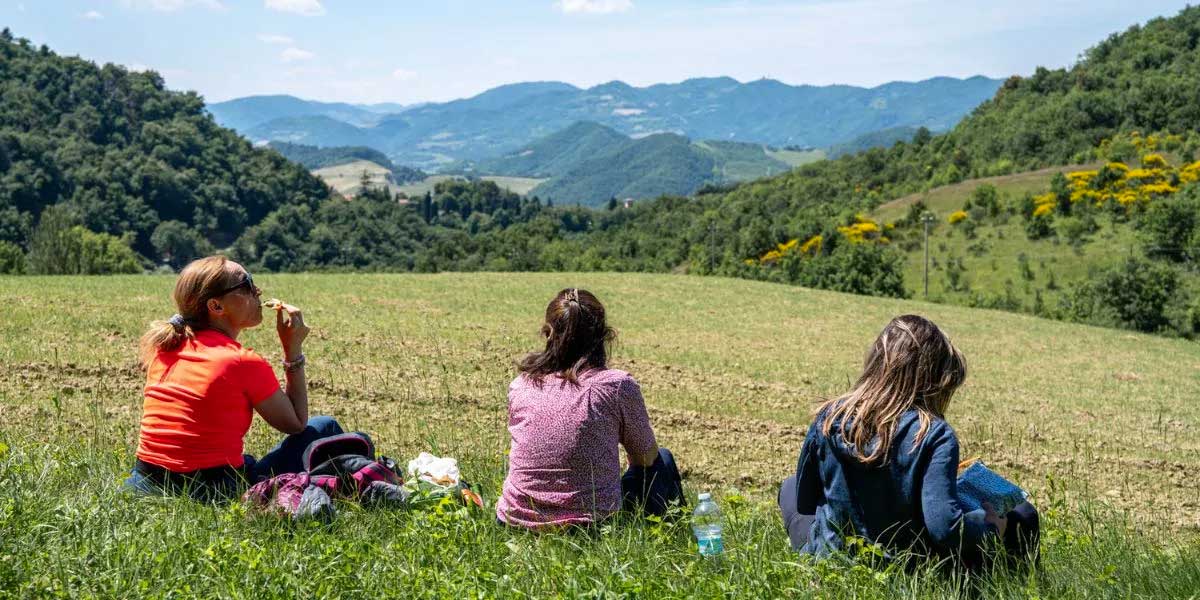
Time is one of the first things that changes when we travel on foot.
In everyday life, our hours are often organised around commitments, appointments and everything we need to accomplish before the day is over. On a walking holiday, the rhythm becomes simpler. There is a route to follow, a destination to reach and a certain distance to cover, but there is also room for everything that happens in between.
A conversation over breakfast might last a little longer. You might stop to admire a landscape that looks entirely different in the morning light, or spend an unexpected half-hour exploring a village you hadn't thought much about when planning the journey.
Of course, walking holidays still involve schedules, distances and practical arrangements. Slowing down doesn't mean abandoning all structure. It means allowing the journey itself, rather than a constantly expanding list of things to see, to become the focus.
There is something valuable in spending an entire day moving between two places that might be only a short drive apart.
You begin to understand the distance between them. You notice how the landscape changes, where the cultivated fields give way to woodland, how one village relates to the next.
Time stops being something to fill and becomes something you can experience.
And perhaps that is one of the first lessons of travelling deeper: the hours we remember most fondly are not always the ones in which we accomplished the most.
Think of a place you have always wanted to visit.
Perhaps you know its most famous monument, its main square or the view that appears in every photograph. These are often the images that first make us curious about a destination, and there is nothing wrong with wanting to see them.
But a place is never made up of its highlights alone.
It is also the landscape surrounding them, the roads that connect them, the food people prepare, the languages and dialects spoken, the stories that are remembered and those that are less often told.
Walking gives us the opportunity to encounter some of these elements gradually.
Along the Via Francigena, for example, the historic towns are only part of the experience. The countryside between them helps explain why settlements developed where they did, how people travelled and how different parts of the territory remain connected.
The same principle applies whether you are walking through the vineyards of Tuscany, the villages of Sicily or the coastal landscapes of Portugal.
You don't have to visit every museum or know the history of every building. Sometimes it is enough to arrive with a little curiosity.
In our Travel Deeper series, we suggested preparing for a journey through novels, local music, traditional recipes, legends or even a few words of another language.
These are small invitations to look beyond what is immediately visible. They give us questions to carry into a place, rather than simply a list of answers to collect.
And walking gives us time to notice what we find.
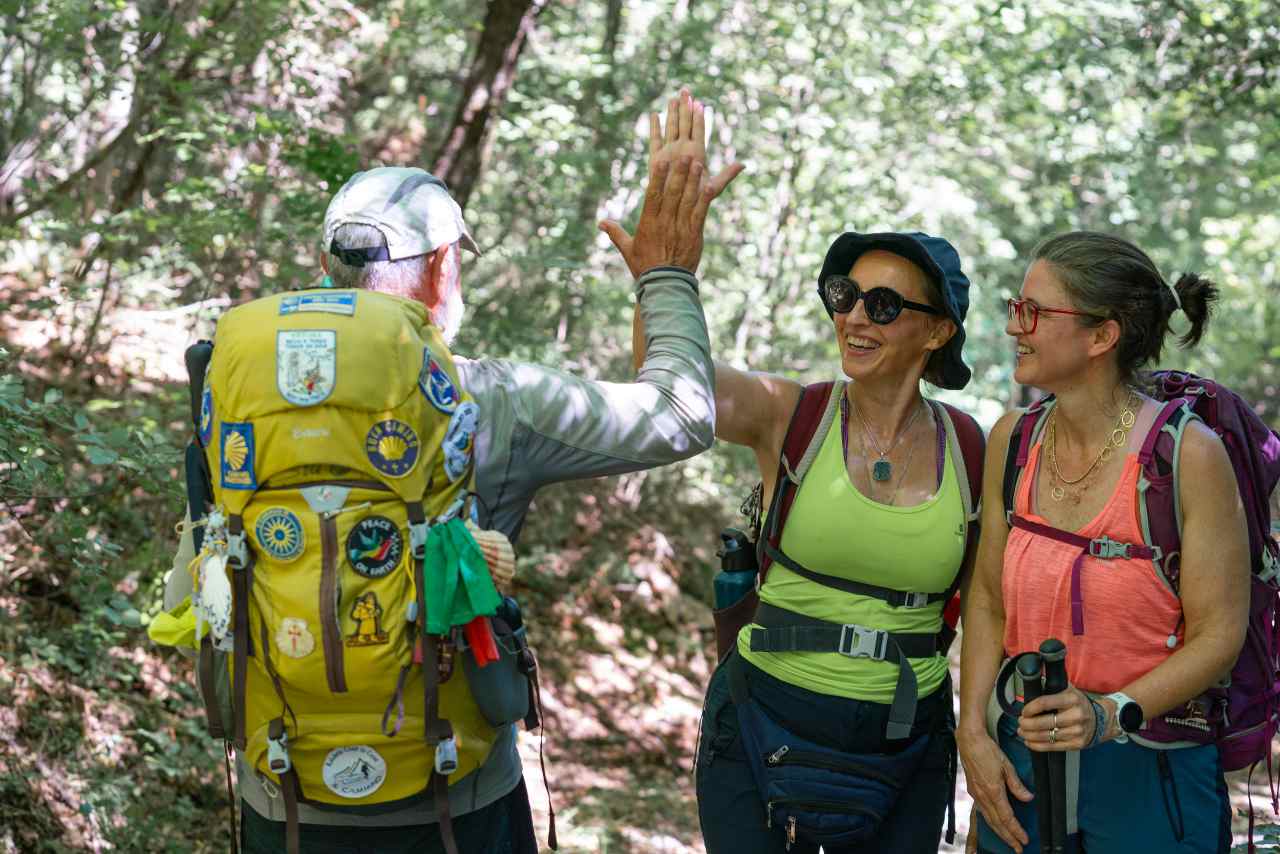
One of the things we remember most vividly about travelling is often something we could never have planned: another person.
A fellow walker who accompanies us for part of a stage. Someone who helps us find our way. A conversation with a host over dinner. Or simply the pleasure of sharing a long day outdoors with someone we love.
Not every encounter needs to become a meaningful friendship, and not every journey has to be filled with conversation.
Sometimes the exchange is brief: a recommendation, a smile, a few words in a language we are still learning. Other times, the most important person in the experience is someone who has been travelling beside us all along.
Walking creates a particular kind of shared time. There are hours in which conversation comes easily, others in which silence feels just as comfortable, and the small satisfaction of reaching the end of a stage together.
Travelling alone offers something different but equally valuable: the freedom to follow your own thoughts and the possibility of meeting others along the way.
Travelling deeper is not necessarily about meeting more people. It is about being more open to the people who become part of our experience.
And it also means remembering that the places we visit are home to communities with their own routines, responsibilities and priorities. Being curious about them should always go hand in hand with respecting their time and space.
In our first Travel Deeper article, we introduced the idea of keeping a travel journal, collecting small memories or choosing a personal travel talisman.
Not necessarily something expensive or particularly beautiful. Perhaps a postcard, a book found in a local shop, a ticket kept between the pages of a notebook.
The value of these objects is not in what they cost, but in what they help us remember.
The same is true of writing.
A travel journal doesn't have to be a detailed account of every stage. It might contain a few lines about something that surprised you, a sketch of a landscape, the name of a person you met or a question you found yourself thinking about during the walk.
You might even begin before leaving, writing down what you hope to find, and return to those notes once you are home.
The purpose is not to document everything.
It is to pay attention.
Sometimes, when we are constantly trying to capture a journey, we can lose sight of the experience itself. Choosing what deserves to be remembered asks us to notice what has genuinely mattered.
And these are not always the most spectacular moments.
They might be an ordinary lunch after a demanding morning, a quiet stretch of woodland or the unexpected pleasure of recognising a place you have only just arrived in.
The memories that stay with us are not always the ones we travelled there to make.
There is another dimension to travelling slowly, and it concerns the places that welcome us.
A walking holiday can encourage a different relationship with the territory, not only because of how we experience it, but also because of the choices we make along the way.
Moving between communities creates opportunities to stay in locally run accommodation, eat in small restaurants, buy from local businesses and discover places that might receive less attention from conventional tourism.
These choices can help distribute the economic benefits of travel across a wider area.
They are also part of what we mean when we talk about travelling with greater awareness.
In our Travel Deeper series, we encouraged small gestures of care: carrying a refillable bottle, respecting the trails we use, supporting local businesses where possible and leaving places as we would hope to find them.
None of these choices makes a journey automatically sustainable. Walking holidays still have environmental impacts, including those associated with transport, accommodation and the services that make a trip possible.
But slowing down can give us more opportunities to consider those impacts and make thoughtful decisions.
At SloWays, this is part of a wider commitment to working with local providers, choosing family-run accommodation where practical and developing itineraries that can help support local economies and bring attention to lesser-known destinations.
You can learn more about these commitments on our Sustainability page.
Travelling better is not only about what a place gives us. It is also about how we choose to be there.
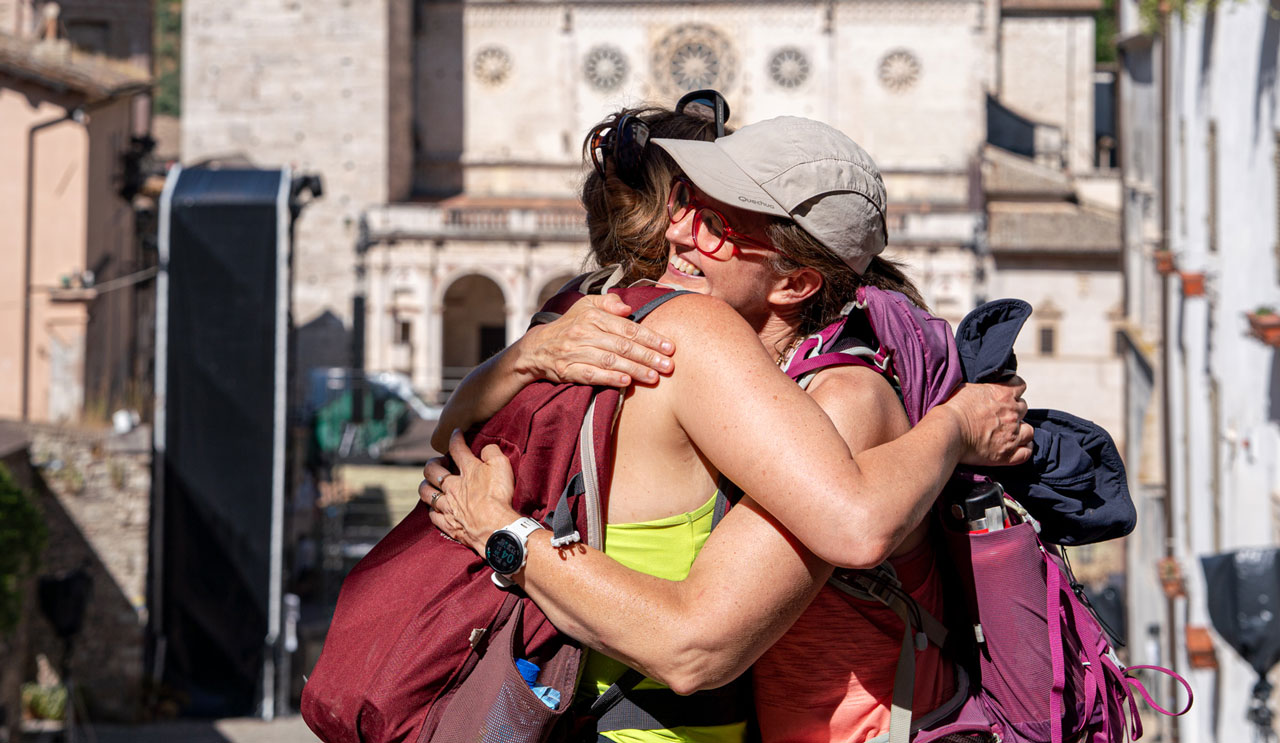
There is a temptation, when talking about meaningful travel, to suggest that every journey should transform us.
That we should return home with a completely new perspective, a different understanding of life or a story about overcoming something extraordinary.
But we don't think travel needs to carry that expectation.
Sometimes a holiday is simply a chance to rest, enjoy good food, spend time outdoors or be with people we love. Those are valuable reasons to travel in themselves.
And yet, even without setting out to change anything, we may discover that something has shifted.
Perhaps we have completed a walk we once thought was beyond our abilities. Perhaps we have become more comfortable with unfamiliar situations, learned to enjoy our own company or discovered how satisfying a simpler daily rhythm can be.
Sometimes the change is even smaller.
We return home wanting to spend more time outdoors. We remember a conversation that made us reconsider an assumption. We find ourselves looking differently at a familiar landscape, or appreciating the pleasure of an unhurried afternoon.
These are not dramatic transformations, and they don't need to be.
In our Travel Deeper series, we explored the idea that the journey continues, in a sense, after we return. What we have experienced becomes part of our memories, our habits and the way we understand the world around us.
We may not notice it immediately.
Sometimes it takes being home again to understand what a journey has given us.
Not necessarily for everyone, or on every occasion.
There are wonderful journeys that involve moving quickly, visiting several cities or making the most of a short amount of time. And there are slow journeys that don't go quite as we hoped.
Travelling slowly is not a guarantee of deeper experiences, meaningful encounters or personal growth.
What it offers is the possibility of making more room for them.
Room to notice what lies between the places we planned to visit. To spend time with people without constantly looking towards the next activity. To become curious about the everyday life of a destination, and to make choices that show respect for the communities welcoming us.
It is also an invitation to reconsider what we mean by getting the most out of a holiday.
Perhaps the value of a journey is not always measured by how much ground we cover, but by how much of what we experience we carry home.
That, for us, is the heart of travelling deeper.
Not necessarily going further, staying longer or doing more.
Simply giving ourselves the chance to experience a place, and our time within it, more fully.
Written by the SloWays Team
"
 Nominee Best Specialist Tour Operator 2026