

Is the Way of St Francis suitable for beginners? How far will you walk each day, and how much preparation do you need? Here's what to expect from this beautiful pilgrimage route through central Italy.
Some walking routes are as much about the journey within as they are about the kilometres covered. The Way of St Francis, also known as the Via di Francesco, is certainly one of them. Following in the footsteps of St Francis of Assisi, this remarkable trail crosses some of central Italy's most beautiful landscapes, connecting medieval villages, peaceful forests, rolling hills and places that played an important role in the saint's life.
But while the spiritual dimension is an essential part of the experience, the physical side of the journey shouldn't be underestimated. The Way of St Francis is a wonderfully rewarding walking route, but it also includes challenging climbs, steep descents and long days on your feet.
Does that mean you need to be an experienced hiker to enjoy it? Not necessarily. With the right preparation, a realistic choice of itinerary and a willingness to take things at your own pace, the Way of St Francis can be an accessible and deeply satisfying experience for many walkers.
Here's everything you need to know about its difficulty, the terrain you'll encounter and how to prepare before setting off.
If you’re looking for inspiration for your next Camino, or want help choosing the itinerary that best matches your needs,
take our quiz at the link below!

The first thing to understand is that the Way of St Francis isn't a single, uniform trail. It's a network of routes connecting places associated with the life of St Francis, with different itineraries leading towards Assisi and continuing south to Rome.
The Northern Route, traditionally starting at the Sanctuary of La Verna in Tuscany and ending in Assisi, crosses the Apennine landscapes of Tuscany and Umbria. Expect wooded paths, beautiful mountain scenery, quiet valleys and a considerable amount of climbing and descending.
The Southern Route, connecting Rome and Assisi, offers a different combination of landscapes, taking walkers through the countryside of Lazio and Umbria, historic towns, agricultural valleys and hilly terrain.
Both routes include sections that are relatively gentle and others that demand greater physical effort. This is why it's difficult to assign one level of difficulty to the entire journey.
Generally speaking, the Way of St Francis is best described as a moderate to challenging walking route, depending on the section you choose. It doesn't require technical mountaineering skills, but a reasonable level of fitness, comfortable walking shoes and some experience of walking on uneven terrain will make the experience much more enjoyable.
One important thing to remember is that distance alone doesn't determine how difficult a day will be. A 15-kilometre walk with several steep climbs can be considerably more tiring than a 20-kilometre walk across relatively flat countryside. When planning your journey, it's worth looking at the elevation profile of each stage, rather than focusing exclusively on the number of kilometres.
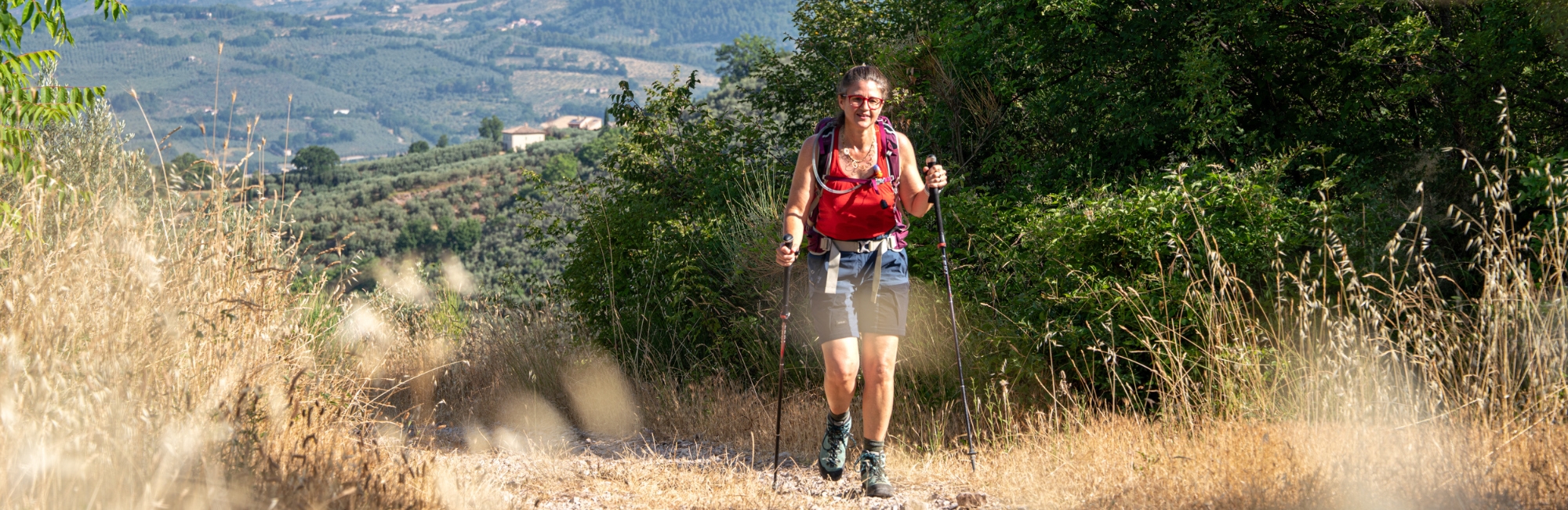
On the Way of St Francis, daily distances vary considerably depending on the itinerary and the stages you choose. Many walkers cover approximately 15 to 25 kilometres per day, although some stages are shorter and others considerably longer.
For someone accustomed to occasional countryside walks, 20 kilometres might sound perfectly manageable. And on a single day, it often is. The real challenge of a long-distance walking holiday, however, lies in repeating that effort over several consecutive days.
Your body needs to adjust not only to the distance but also to the cumulative fatigue, particularly when the route includes frequent changes in elevation. You might feel comfortable after your first day, only to discover that your legs are noticeably more tired when you set off the following morning.
This is one of the reasons why choosing the right itinerary is so important. If you're relatively new to multi-day walking holidays, there's no need to tackle the entire route at once. Walking a shorter section of the Way of St Francis can be just as meaningful as completing a longer pilgrimage, allowing you to experience its landscapes, atmosphere and cultural heritage without pushing yourself beyond your limits.
It's also worth remembering that walking times are influenced by much more than distance. Weather conditions, terrain, fitness and the number of stops you make along the way can all affect how long a stage takes. And on a route as rich in history and natural beauty as this one, you'll almost certainly want to stop regularly.

One of the defining characteristics of the Way of St Francis is its varied terrain. Unlike some long-distance routes that follow relatively flat valleys or well-maintained tracks for much of their length, this itinerary frequently climbs into the hills before descending towards villages and valleys.
Elevation gain is one of the main factors to consider. Some stages involve sustained uphill walking, while steep descents can place considerable pressure on your knees, particularly towards the end of a long day. The Northern Route, with its Apennine landscapes, is especially known for its changes in elevation.
The walking surfaces also vary. You'll encounter forest trails, gravel tracks, rural paths, stretches of asphalt and occasionally rocky or uneven ground. While technical hiking experience generally isn't required, good balance and confidence on different surfaces are useful.
Weather is another important consideration. Central Italy can be surprisingly warm during the summer, particularly on exposed sections of the trail, while spring and autumn can bring rain and muddy paths. Conditions can also change considerably with altitude, making it important to pack suitable clothing even when the forecast looks promising.
Finally, there's the mental aspect of walking for several days. Long-distance hiking requires patience, flexibility and the ability to adjust your expectations. Some days will feel effortless, while others may be more demanding than anticipated. Learning to accept this natural rhythm is part of the experience.

Yes, beginners can walk sections of the Way of St Francis, provided they choose an itinerary that matches their fitness level and prepare appropriately.
If you've never taken a multi-day walking holiday before, it may be helpful to start with a shorter itinerary rather than committing immediately to several weeks on the trail. This will give you an opportunity to discover how your body responds to consecutive days of walking and whether you enjoy the particular rhythm of a long-distance journey.
It's also important to distinguish between being new to hiking and being physically unprepared. Someone who regularly walks, cycles or enjoys other forms of exercise may find the transition to a walking holiday relatively straightforward, even without previous pilgrimage experience. On the other hand, someone who leads a predominantly sedentary lifestyle will benefit from a more gradual approach.
The key is to be realistic about your abilities and expectations. There's no particular achievement in arriving at the end of each day completely exhausted, especially when so much of the pleasure of the Way of St Francis comes from the places, encounters and landscapes along the route.
Choosing a well-paced itinerary, allowing time for breaks and travelling without the weight of a large backpack can all help make the experience more comfortable.

You don't need an intensive athletic training programme to prepare for the Way of St Francis, but building up your walking endurance before departure is strongly recommended.
Ideally, begin preparing at least six to eight weeks before your trip, or earlier if you're starting from a low level of physical activity. The aim isn't simply to walk further, but to help your body become accustomed to the kind of effort you'll experience on the trail.
Start with distances you can comfortably manage and increase them progressively over the following weeks. If you're currently used to walking five or six kilometres at a time, for example, there's little benefit in immediately attempting a 20-kilometre hike.
Instead, gradually introduce longer walks, ideally including some routes of 12 to 18 kilometres as your departure approaches. The exact distances will depend on your chosen itinerary and your starting fitness level.
Try to include at least a few walks on consecutive days. This will help you understand how your legs and feet respond to repeated activity, which is one of the most important aspects of preparing for a multi-day journey.
Since elevation changes are such an important feature of the Way of St Francis, training exclusively on flat ground won't fully prepare you for the experience.
Whenever possible, include hills, woodland trails or routes with a mixture of climbs and descents in your training walks. If you live in a relatively flat area, stairs or inclined treadmill sessions can provide useful additional preparation, although walking on natural terrain remains preferable.
Pay particular attention to descents, which can be surprisingly demanding on your knees and leg muscles.
One of the simplest ways to avoid unnecessary discomfort is to wear your walking shoes regularly before departure.
Whether you prefer lightweight hiking boots or trail shoes, the most important thing is that they're suitable for the terrain, fit properly and have already been tested on longer walks.
New shoes can cause blisters and pressure points, even when they feel comfortable during a short walk around town. Training is also an opportunity to experiment with walking socks and identify the combination that works best for you.
Walking is the most relevant form of preparation, but a little additional strength training can also help.
Simple exercises such as squats, step-ups and controlled lunges can strengthen the muscles that support your knees and hips, while balance exercises can improve stability on uneven ground.
You don't need an elaborate gym routine. Consistency matters more than intensity, and even a few short sessions each week can complement your walking preparation.
Packing for the Way of St Francis is largely a question of finding the right balance between comfort, practicality and weight.
The essentials include comfortable walking shoes, breathable clothing, a waterproof jacket, sun protection, a refillable water bottle and a small first-aid kit with blister care supplies. Walking poles can also be particularly useful on stages with significant elevation changes, helping with stability and reducing some of the strain associated with steep descents.
Layering is generally the most practical approach to clothing, especially during spring and autumn, when temperatures can vary considerably throughout the day.
If you're organising the journey independently and carrying everything you need, backpack weight becomes an important consideration. Even a few unnecessary items can make a noticeable difference after several hours of walking.
On a self-guided walking holiday with luggage transfers, however, you can travel with a much lighter daypack, carrying only what you need for the day's walk. This can make a significant difference to your comfort, particularly if you're new to long-distance hiking or prefer to concentrate on the experience rather than the logistics.

Spring and autumn are generally the most pleasant seasons for walking the Way of St Francis, thanks to milder temperatures and the changing colours of the countryside.
Between April and June, the landscapes of Tuscany, Umbria and Lazio are often particularly beautiful, with green hills, flowering meadows and comfortable conditions for walking. Spring weather can nevertheless be unpredictable, especially in higher areas, so waterproof clothing remains essential.
September and October are also excellent months to consider. The intense heat of summer gradually gives way to cooler temperatures, while vineyards, olive groves and forests take on the colours of autumn. Daylight hours become shorter as the season progresses, however, making it important to plan each stage accordingly.
July and August can be more challenging because of the heat, particularly along exposed sections and at lower elevations. If you choose to walk during summer, early starts, adequate hydration and careful planning are particularly important.
Winter brings its own difficulties, especially along the higher sections of the Northern Route, where cold weather, snow or icy conditions may affect the trails.
Perhaps the most important thing to remember when preparing for the Way of St Francis is that there's no single correct way to experience it.
For some walkers, the goal is to complete a long pilgrimage over several weeks. For others, it's to spend a few days exploring the landscapes around Assisi, discovering historic villages and experiencing the particular sense of peace that accompanies travelling on foot.
Both approaches are equally valid.
At SloWays, we believe that a walking holiday should leave room for curiosity, unexpected discoveries and the simple pleasure of being somewhere new. Our self-guided walking holidays allow you to enjoy the independence of travelling at your own pace, with carefully planned itineraries, selected accommodation and practical support along the way.
The Way of St Francis is a particularly rewarding place to discover this way of travelling. Its beauty lies not only in its famous destinations, but also in the quieter moments between them: a woodland path in the morning, a village appearing on the horizon, a conversation over lunch or the satisfaction of reaching your destination after a day outdoors.
With a little preparation and the right itinerary, even the more demanding sections can become part of what makes the journey memorable.
Explore our walking holidays along the Way of St Francis and find the itinerary that suits your pace.
The Way of St Francis is generally considered a moderate to challenging walking route, although difficulty varies significantly between sections. Some stages involve sustained climbs, steep descents and uneven terrain, while others are more accessible. A reasonable level of fitness and preparation is recommended.
Yes, beginners can enjoy the Way of St Francis, particularly if they choose a shorter itinerary with manageable daily distances. It's advisable to build up walking endurance before departure and select stages that match your physical abilities.
Daily distances vary depending on the itinerary, but many stages cover approximately 15 to 25 kilometres. Some are shorter, while others are longer or involve more demanding elevation changes. It's important to consider both distance and elevation when planning your walk.
Sturdy, comfortable walking footwear with good grip is essential. Depending on the season, terrain and personal preference, suitable hiking boots or trail shoes may both be appropriate. Whichever you choose, make sure you've tested them on longer walks before departure.
For someone with a reasonable baseline level of fitness, six to eight weeks of progressive walking preparation can be a useful starting point. If you're not accustomed to regular exercise, allow more time and build up gradually. Include longer walks, hills and consecutive walking days whenever possible.
May, June, September and early October are often particularly good choices, offering generally comfortable walking temperatures and attractive landscapes. Conditions vary by altitude and year, so it's always important to check the forecast and seasonal trail conditions before setting off.
Written by the SloWays Team
 Nominee Best Specialist Tour Operator 2026


