The question comes up every time someone starts planning their first serious walking holiday: do you move from place to place each day, sleeping somewhere new every night, or do you settle into one comfortable base and explore the surrounding trails on foot?
Both formats are legitimate walking holidays. Both can be self-guided. Both can include pre-booked accommodation and full logistical support. The difference is structural, and that structure shapes almost everything else about how your trip feels on the ground.
The short version: point-to-point trips suit walkers who want a sense of journey and are comfortable committing to a planned daily progression. Hotel-based trips suit walkers who want to explore one area in depth, or whose group has mixed fitness levels.
The longer answer depends on your destination, your group, and what you actually want from the experience.
If you’re looking for inspiration for your next Camino, or want help choosing the itinerary that best matches your needs,
take our quiz at the link below!
Before comparing them, it helps to be precise about what these two formats involve in practice.
On a point-to-point walking holiday, you walk from one overnight stop to the next. Each morning you leave your accommodation and walk the day's stage to arrive somewhere new by evening. On many organised self-guided trips, your main luggage is transferred ahead while you walk with a daypack. On walking days, this pattern repeats as you progress along the route.
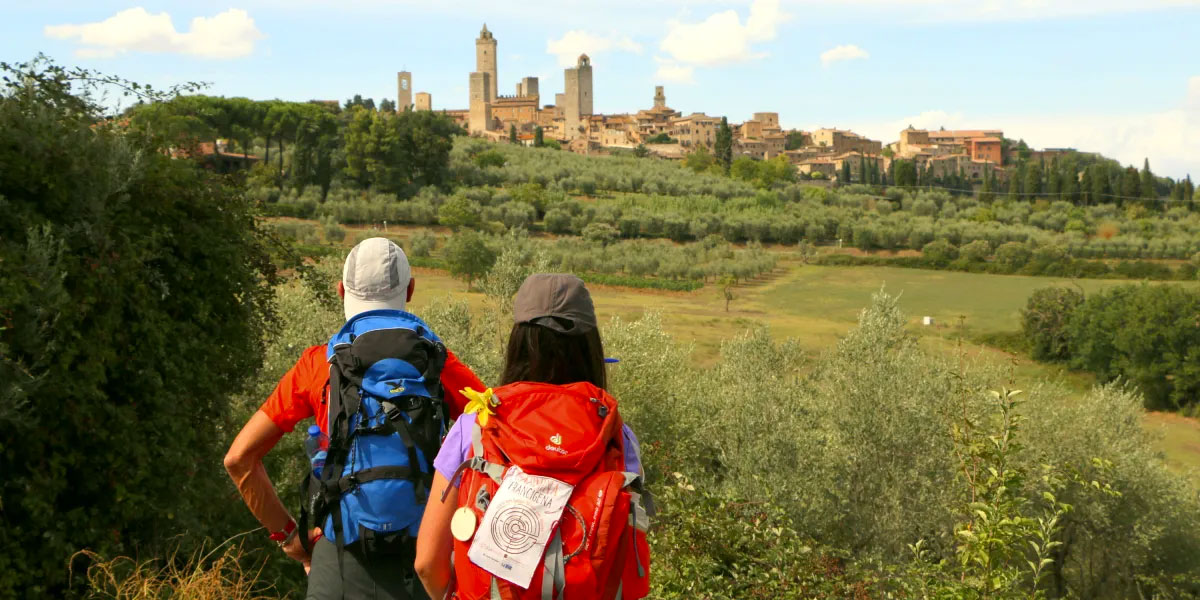
The great pilgrim routes are the clearest example. Walking the Via Francigena from Lucca to Siena, for instance, means covering around 115 kilometres between Lucca and Siena, with a different village or town marking the end of each walking day. You are genuinely travelling on foot. The landscape changes around you. The sense of progress is cumulative and earned.
Key characteristics:
A new location every night
A sequence of daily stages connecting one overnight stop to the next
On many organised self-guided trips, luggage is transferred between overnight stops
Route is linear: you start at point A and finish at point B
Skipping or adapting a stage generally requires more logistical planning
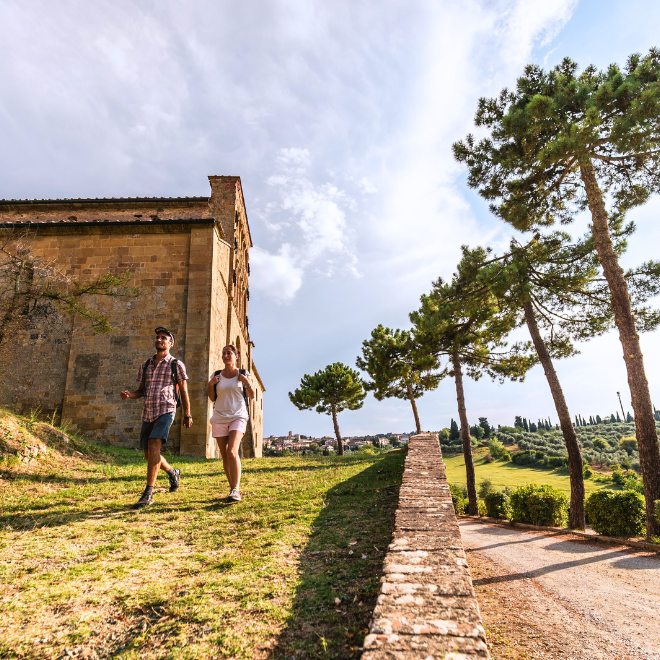
On a hotel-based walking holiday, you stay in one property for the duration of the trip, or in two properties over two distinct areas (sometimes called a twin-centre format). Each day you head out on a different walk from that base, then return to the same hotel in the evening.
A good example is Lake Como Mountain Walks: five days based in one location, with a different trail each day exploring the surrounding mountains and lakeshore. Your luggage stays in your room. You do not need to pack up every morning.
Key characteristics:
Same hotel every night (or two hotels over two areas)
A programme of walks from the same base, varying in length and terrain
No daily luggage transfers between accommodations
No linear route: you return to the same base each evening
Skipping or changing a walking day is generally simpler, as your accommodation is not affected
The structural difference between the two formats creates a cascade of practical consequences. These are the ones that matter most when planning.
Point-to-point:
Luggage: main bag moves between accommodations; you walk with a daypack
Fitness commitment: daily stages follow a planned progression; skipping one may require alternative transport
Flexibility: more structured; changes may affect onward accommodation
Sense of journey: progressive; you travel through the landscape
Logistics complexity: higher; luggage transfers, accommodation booked as a sequence
Best for: pilgrim routes, long trails, named long-distance paths
Hotel-based (cluster):
Luggage: main bag stays at your base throughout
Fitness commitment: skipping or adapting a walking day is usually simpler
Flexibility: more adaptable; changes generally do not affect accommodation
Sense of journey: immersive; you explore one area in greater depth
Logistics complexity: lower; one or two properties, no daily transfers
Best for: island walks, mountain areas, mixed-ability groups
The real planning implication: point-to-point trips require more commitment upfront. Once you book, the stages form a chain. If someone in your group needs to skip a stage, reaching the next overnight stop may require a taxi, bus, or another transport solution. On a hotel-based trip, skipping or adapting a walking day is generally simpler because there is no onward accommodation to reach on foot.
Neither format is objectively better. The right choice depends on what you are actually looking for from your walking holiday.
You are drawn to a specific long-distance route with its own history and identity. The Camino de Santiago, the Via Francigena, the St. Francis Way: these routes exist as linear journeys. Walking them as a cluster trip would mean driving between stages and losing the thread entirely. The meaning is in the progression, in the fact that each evening you are somewhere you were not the night before.
Point-to-point also suits walkers who enjoy the rhythm of a planned daily progression and are comfortable committing to the stages of their chosen itinerary. The format does not imply a particular difficulty level: SloWays offers easy versions of several point-to-point routes, including the Via Francigena Easy from Lucca to Siena, designed for walkers who want the journey without the most demanding terrain.
You want to settle into one area and explore its landscape in greater depth. Staying in one place for five or six nights gives you time to understand a valley, a coastline, or a mountain massif properly. This is particularly true for destinations like the Dolomites or the Greek islands, where the terrain offers richly varied walking within a compact radius.
Hotel-based trips can work particularly well for:
Mixed-ability groups. Staying at the same base can make it easier to adapt a walking day when people in the same party have different needs or energy levels.
Walkers new to multi-day itineraries. Without a chain of overnight stops to maintain, there is more room to find your pace in the first couple of days.
Destinations with trail networks suited to loop or radial walks. Some areas are simply better explored from a fixed base than walked through linearly.
Some itineraries split the difference. A twin-centre format uses two bases, typically in contrasting areas, with three or four nights at each. You get some of the depth of a cluster trip with a genuine change of scene between the two halves. The Two Center Cinque Terre Hiking is a good example: two bases along the Ligurian coast, different trails from each, with a single move between them.
This format works well for travellers who want variety without the daily logistical rhythm of a full point-to-point trip.
The format and the destination are not independent decisions. Some landscapes are simply better suited to one structure than the other.
Long-distance cultural routes are the clearest case. The Via Francigena crosses regions, not just a single valley. The same applies to the Via degli Dei from Bologna to Florence: a route that crosses the Apennines and arrives at one of the world's great cities. The arrival is the point.
Linear coastal paths also tend to suit a point-to-point structure. Walking the Rota Vicentina in Portugal from north to south along the Atlantic coast gives you a genuine sense of travelling through a landscape rather than sampling it.
Some destinations lend themselves well to hotel-based itineraries because several different walks are accessible from the same base. The Cyclades: Naxos and Santorini itinerary is built around this logic: cluster walking from each island base, with the ferry crossing as the single big move between them.
Mountain valleys work similarly. In the Dolomites, hut-to-hut walking is one excellent option, but staying in a valley town and walking up into the peaks each day is a practical alternative for travellers who want hotel comfort throughout. The Dolomites Val Badia Hiking itinerary uses this structure: one base, multiple ascents, consistent comfort in the evening.
Practical note: if a destination has good public transport connections between trailheads, a hotel-based format becomes significantly easier to manage. You can walk a one-way trail and take a bus back to your base. If public transport is sparse, point-to-point can actually simplify logistics rather than complicate them.
If you are still unsure which format is right for you, work through these:
1. Are you drawn to a specific named route? If following the progression of a named route is part of what attracts you, point-to-point is likely to be the natural choice. The Camino de Santiago, the Via degli Dei, the Dolomites Alta Via: each has a direction, and its character comes partly from that.
2. How consistent is your energy likely to be across a week? If you expect variable days, a hotel-based format gives you more room to adapt without affecting the rest of the trip. On a point-to-point itinerary, each stage needs to be covered, or an alternative transport solution arranged.
3. Are you travelling with others at different fitness levels? A hotel-based format can work particularly well for mixed-ability groups because adapting or skipping a walking day does not affect the group's onward accommodation.
4. How important is the sense of arrival? One of the most powerful moments in any point-to-point trip is arriving in a new town at the end of a long day, knowing you walked every step of the way. If that feeling matters to you, a hotel-based trip will not replicate it.
5. How much do you want to know a single place? A week in one valley, one island, or one mountain area gives you something that linear travel rarely does: familiarity. You start to recognise the landscape, the rhythms, the faces. That is a different kind of travel, and for some people it is the more rewarding one.
Once you have chosen your format, the practical planning diverges in a few specific ways.
On a point-to-point trip, accommodation has to work as a sequence: availability at one overnight stop can affect the structure of several stages. On popular routes in peak season, accommodation in smaller overnight stops can be limited, and a gap in the chain may mean adjusting the surrounding stages.
On a hotel-based trip, accommodation planning is concentrated in one or two bases rather than a chain of overnight stops. That does not mean booking is always straightforward, but the dependency between nights is simpler.
On SloWays point-to-point itineraries where luggage transfer is included, your main bag is collected from the hotel each morning and delivered to the next one. You walk with only a daypack. The SloWays allowance is one bag per person, up to 20 kg, collected at a set time each morning. Check your specific itinerary documentation for the exact details.
On a hotel-based trip, your bag stays in your room. The luggage transfer question disappears entirely.
With a point-to-point itinerary, the start and finish are different places, so arrival and departure logistics need to be planned accordingly. Depending on the route, this may involve public transport, a private transfer, or a combination of the two.
With a hotel-based trip, you return to the same base after each walk, which simplifies the daily route structure. You still need to plan how to reach the base at the start of the trip and leave at the end, but there is no separate return journey from a different finishing point.
On a hotel-based trip, skipping or changing a walking day because of poor weather is often easier: your accommodation does not depend on completing that stage. On a point-to-point trip, the decision requires a bit more thought, particularly if you have a hotel booked at the other end of the stage.
Both formats can deliver an excellent walking holiday. The choice is not about quality; it is about how the trip is built around the landscape.
If you want a journey, with all the weight and meaning that word carries, point-to-point gives you that sense of progression. If you want to settle into one place and explore its landscape in greater depth, hotel-based gives you a different kind of intimacy with the terrain.
There is no format that is universally better. The right one is the one that fits your destination, your group, and what you actually want to bring home from the experience.
Ready to choose your format? Browse SloWays walking holidays across both structures, from multi-week pilgrim routes to compact island adventures. If you are unsure which itinerary fits your travel style, the team is available to help you find the right match.
Written by the SloWays Team
 Nominee Best Specialist Tour Operator 2026